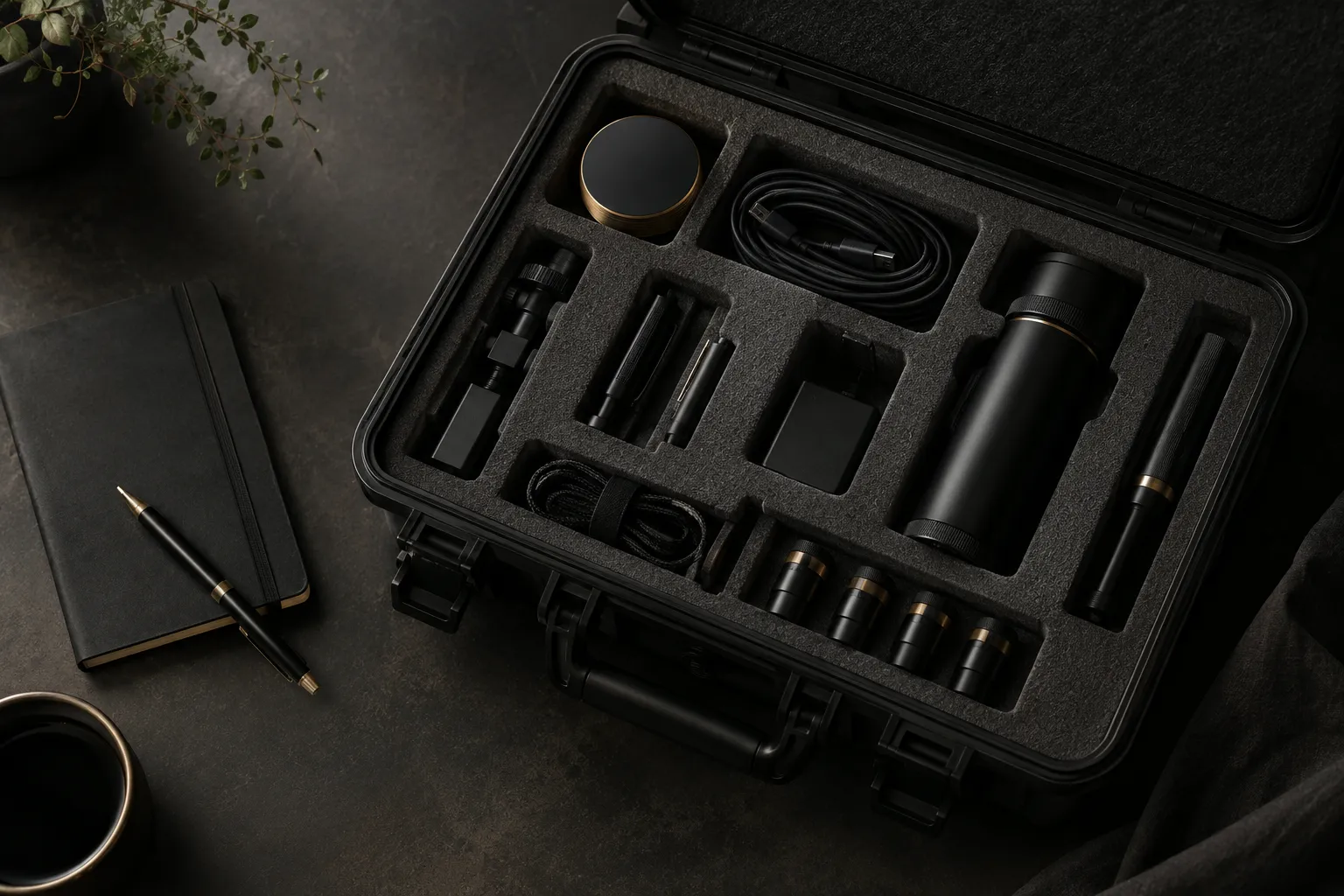
Post-Incident Surveillance Breach Forensics: TSCM Evidence Preservation & Litigation Support for Ontario Businesses (2026)
By Imperial Consulting Unit Inc. · Licensed PI · TSCM Certified
Post-Incident Surveillance Breach Forensics: TSCM Evidence Preservation & Litigation Support for Ontario Businesses (2026)
The moment a surveillance device is discovered inside a boardroom, executive office, or corporate facility, a clock starts. Decisions made within the first 72 hours will either preserve or permanently destroy your evidentiary record — and with it, your ability to pursue civil litigation, criminal referrals, or insurance claims. In 2026, Ontario businesses cannot afford to treat post-incident TSCM as an afterthought. Forensically sound evidence preservation, court-grade chain-of-custody documentation, and expert witness positioning must begin immediately — before IT staff, facilities managers, or cleaning contractors inadvertently contaminate the scene.
This guide is written for corporate counsel, CISOs, insurance claims adjusters, and business owners confronting an active surveillance breach. If devices may still be present in your facility, start with our TSCM office sweep service. To discuss a post-incident engagement with a Licensed PI, request a confidential consultation now.
What Is Post-Incident TSCM? Forensic Counter-Surveillance After a Breach Discovery
Standard TSCM is preventive: a licensed investigator scans for surveillance devices before they cause harm. Post-incident TSCM is fundamentally different in purpose, urgency, and legal weight. When a device has already been discovered — or when a breach is suspected from unexplained data loss, network anomalies, or evidence of unauthorized entry — the TSCM engagement becomes a forensic investigation. The objective shifts from detection to documentation, preservation, and litigation support. Every action taken from the moment of discovery must be recorded and defensible under Ontario's Rules of Civil Procedure and the Evidence Act RSO 1990.
For the warning signs that commonly precede a breach discovery, see our guide on corporate espionage warning signs your office may be bugged.
The 3–5 Day Response Window
Legal counsel and forensic investigators consistently identify a 3–5 day critical window following breach discovery. Within this period, evidence is most intact, devices may still be transmitting to recoverable interceptors, and the causal chain between unauthorized surveillance and business harm is clearest. Beyond this window: a court may draw an adverse spoliation inference if evidence was in a party's control and not preserved; insurance carriers impose 30–60 day breach notification deadlines that risk coverage denial without prompt professional documentation; and digital exfiltration artifacts — router logs, network anomaly records, access card data — are routinely overwritten within 72 hours by standard IT maintenance cycles.
How Routine Cleanup Destroys Evidence
The most common evidence contamination is not deliberate — it is routine cleanup. An office manager who removes a suspicious device to examine it, an IT team that resets network equipment to "restore operations," or facilities staff who patch a wall cavity immediately after a discovery will each inadvertently compromise forensic integrity. Ontario courts have found spoliation in cases where in-house teams acted without engaging independent forensic counsel first. Engaging a certified TSCM forensic sweep before any premises cleanup is the single most important protective step available.
The First 72 Hours: Emergency Protocol After Discovering Surveillance Devices
Immediate post-discovery response follows a structured six-step protocol. Deviation — particularly the order in which legal counsel, TSCM investigators, and insurers are engaged — can permanently undermine both litigation outcomes and coverage eligibility.
| Step | Action | Why Sequencing Matters |
|---|---|---|
| 1 | Isolate the premises; log all access | Prevents contamination before TSCM team arrives |
| 2 | Document discovery context on a corporate device | Creates the first chain-of-custody link |
| 3 | Engage legal counsel AND TSCM investigator simultaneously | Retaining TSCM through counsel may attract litigation privilege — direct engagement does not |
| 4 | Notify insurance carrier within 48–72 hours | D&O and cyber liability policies impose notification windows; missing them risks coverage denial |
| 5 | Coordinate with OPP or TPS if criminal breach suspected | Criminal Code Section 184 — coordinate after counsel assesses privilege implications |
| 6 | Brief executive leadership under strict confidentiality | Controls internal disclosure; manages securities disclosure obligations |
Step 3 sequencing is the most consequential decision in the entire post-breach response. When a TSCM investigator is retained directly as a vendor, the resulting report is a business record fully discoverable in civil proceedings — including by the party suspected of installing the device. Retained through legal counsel for the dominant purpose of litigation preparation, the report may attract solicitor-client privilege. Coordinate with corporate counsel on retainer structure before making first contact with any TSCM firm.
Evidence Preservation and Chain of Custody: Ontario's Legal Standard for Court Admissibility
The admissibility of physical surveillance devices in Ontario civil or criminal proceedings depends almost entirely on chain-of-custody integrity. A device recovered without documented handling — however clearly it appears to be surveillance equipment — is vulnerable to exclusion under the Evidence Act RSO 1990. Our detailed guide to the office bug sweep detection process covers how devices are typically concealed and the instrumentation used to find them.
The Duty to Preserve Under Ontario's Rules of Civil Procedure
Rule 30.02 establishes a relevance presumption: any item in a party's possession that may be relevant to reasonably anticipated litigation must be preserved. The moment a corporate decision-maker forms a reasonable belief that proceedings may follow a breach discovery, the legal duty to preserve all evidence — including the premises, network logs, and discovered devices — attaches immediately. Destruction after that moment creates the basis for a spoliation finding. Ontario courts have applied adverse inference remedies in commercial litigation where physical evidence was destroyed by in-house teams acting without forensic oversight.
Physical Chain of Custody: Tamper-Evident Packaging and Expert Certification
For a device to be court-admissible, the following chain must be documented without interruption: discovery identification, in-situ photography, tamper-evident packaging, Faraday enclosure storage (to prevent remote wipe or signal transmission), laboratory analysis, and transfer to legal counsel or law enforcement. Each step requires a signed, timestamped entry. ICUnit's documentation protocols produce a certified chain-of-custody log structured to withstand cross-examination. This level of documentation rigor is one of the key differentiators between a PSISA-licensed forensic investigator and an unlicensed security consultant whose records may be inadmissible.
TSCM Forensics Methodology: RF Detection, NLJD Analysis, and Device Documentation
Post-incident TSCM deploys RF spectrum analyzers, non-linear junction detectors (NLJD), and thermal imaging — but with a different objective than a preventive sweep. Every finding must be photographed, frequency-logged, and recorded in a written report structured for litigation. For a technical overview of TSCM instrumentation, see our guide to Technical Surveillance Countermeasures.
Rapid Assessment Phase (2–4 Hours)
The rapid assessment sweeps the 0–2 GHz RF spectrum, cataloguing known benign sources (enterprise WiFi, cellular repeaters, building management systems) and flagging anomalous transmitters. NLJD sweeps cover high-risk concealment points: wall cavities adjacent to executive offices, HVAC return vents, drop-ceiling voids, network closets, electrical outlet faceplates, and decorative items. The NLJD detects semiconductor junctions regardless of device power state — defeating passive devices that only transmit on interrogation. Thermal imaging identifies heat signatures from active power sources through wall materials. Every positive and negative finding is GPS-timestamped and photographed for the forensic record.
Comprehensive Forensic Phase (8–16 Hours)
When devices are located or when litigation requires exhaustive documentation, the investigation proceeds to the full forensic phase: network topology analysis for unauthorized connected devices, physical documentation of all suspect items, comparison against known device databases, and preparation of a litigation-structured written report. The report explains methodology in terms accessible to a non-technical judge, documents alternative hypotheses considered and rejected, and states the factual basis for each finding and opinion. Where a prior scheduled office TSCM sweep established a clean RF baseline, forensic comparison gains significant precision — often identifying exactly when a device was installed relative to the last clean sweep date.
Ontario Legal Framework: Criminal Code Part VI and Evidence Act RSO 1990
Ontario businesses responding to a surveillance breach operate within two overlapping legal frameworks. In 2026, corporate counsel increasingly rely on TSCM forensic experts to establish the factual predicate for both criminal referrals and civil claims.
Criminal Code Part VI — Unauthorized Surveillance Liability
Criminal Code Part VI, Section 184 prohibits willful interception of private communications, with penalties up to five years imprisonment. Section 186 requires a Superior Court judicial authorization for any lawful interception — a standard no commercial espionage actor obtains. Section 342.1 addresses unauthorized computer system access, which frequently accompanies physical device placement when data exfiltration is the goal. A TSCM forensics report establishing device presence, placement, and function provides law enforcement with the evidentiary foundation for referral under Sections 184, 342.1, and 348 (break and enter to install).
Evidence Act RSO 1990 Section 3 — Expert Admissibility Criteria
Under the Evidence Act RSO 1990 and Ontario common law expert evidence principles, a TSCM investigator's forensic opinion is admissible when four conditions are met: the witness possesses specialized knowledge beyond laypeople; the methodology is reliable and field-recognized; there is an adequate factual basis; and the opinion meaningfully assists the trier of fact. ICUnit satisfies each criterion: PSISA licensing under the Private Security and Investigative Services Act 2005 establishes professional standing, MESA RF Certification establishes technical methodology, and our structured forensic report provides the documented factual basis courts require.
Expert Witness Services: TSCM Testimony for Ontario Litigation and Insurance Claims
Post-incident TSCM generates two distinct work products: the forensic investigation report (factual record of findings) and the expert witness affidavit or testimony (professional opinion on what findings mean for liability, causation, and damages). Both are necessary in litigation; neither substitutes for the other.
What Makes TSCM Expert Testimony Court-Admissible in Ontario
Our founder's credentials as a CAF Veteran, PSISA Licensed PI, and MESA RF Certified TSCM specialist satisfy the qualification standard Ontario courts apply to technical security experts. Post-breach expert testimony typically addresses: device identity and function; likely installation timeline and required access level; what data or communications could have been intercepted given placement and operational period; and whether the breach was targeted versus opportunistic. Pricing for expert witness engagements is custom — quoted privately after a confidential consultation reflecting case scope and anticipated testimony volume.
Privilege Sequencing — The Most Consequential Pre-Engagement Decision
Retaining a TSCM investigator directly means their report is a business record discoverable in civil proceedings — available to the party accused of installing the device. Retaining through legal counsel for the dominant purpose of litigation preparation may allow the report to attract solicitor-client or litigation privilege. Early coordination with corporate counsel to determine the appropriate retainer structure is essential before first contact with any TSCM provider. This sequencing decision cannot be undone retroactively.
Insurance Claim Documentation: What Insurers Require from a TSCM Forensics Report
D&O, commercial crime, cyber liability, and corporate espionage policies increasingly require professional forensic documentation as a condition of coverage assessment. Adjusters evaluating a post-breach claim need four elements:
- Proof of loss: The report confirms device presence, interception capability, and that placement was unauthorized. A PSISA Licensed PI's certification provides the professional credibility insurer files require.
- Causation: The report links device placement and operational period to the claimed business harm — data loss, competitive intelligence theft, or business interruption.
- Mitigation evidence: Documentation of the emergency response timeline demonstrates compliance with the insured's duty to mitigate further loss.
- Expert certification: Many commercial policies now explicitly require a licensed investigator's certification — not merely an IT team's assessment — for claims involving physical surveillance devices. Ontario's PSISA licensing framework means ICUnit's reports carry regulatory-backed standing that unlicensed consultants cannot provide.
Pricing for insurance documentation engagements is custom — quoted privately after a confidential consultation. If your coverage window is active, book a confidential consultation immediately.
Multi-Location Breach Investigation: Synchronized Forensics for Corporate Networks
Sophisticated corporate espionage rarely targets a single location. When a device is found in one facility, the threat model for affiliated offices, fleet vehicles, and executive residences must be immediately reassessed. A phased multi-location response creates a critical vulnerability: a surveillance operator monitoring the first sweep may relocate or deactivate devices at secondary locations before investigators arrive.
ICUnit's multi-location protocol deploys simultaneous teams to all high-priority locations within the same operational window. Investigation sequencing follows a risk-priority model: executive offices and boardrooms first, then finance and legal, then IT infrastructure, then shared conference areas. Where vehicle counter-surveillance sweeps are warranted for key executives whose vehicles may represent secondary intelligence collection points, these are integrated into the same operational plan. The office and vehicle bundle is the most efficient entry point for multi-vector breach response. ICUnit covers Toronto and the full Ontario service area — including Ottawa for clients with federal government or legal sector exposure. Pricing is custom — quoted after a confidential consultation.
Recovery Strategy: Physical Hardening and Post-Breach Re-Sweep Protocols
Device removal is not remediation. Organizations that remove a found device and consider the matter resolved frequently face re-installation within weeks — because the access vulnerability that enabled the initial breach remains unaddressed. ICUnit's post-incident recovery covers six stages: (1) forensically safe device removal with chain-of-custody preservation for legal proceedings; (2) physical vulnerability assessment identifying how and by whom the device was installed; (3) hardening recommendations — access control upgrades, sealed cable trays, lock-cylinder replacement where access card logs show anomalous entry; (4) 48-hour re-baseline RF sweep to confirm no secondary devices remain; (5) network security coordination to assess exfiltration vectors; and (6) a structured recurring TSCM membership — quarterly re-sweeps for twelve months post-incident to detect re-installation attempts.
For organizations without a prior sweep baseline, the post-incident engagement establishes a clean RF fingerprint — the foundational document against which all future office TSCM sweeps compare, reducing investigation time on every subsequent engagement.
Why Ontario Businesses Choose ICUnit for Post-Incident Breach Forensics
In 2026, general PI firms offering TSCM services are not scarce. What is rare — and what post-incident forensics specifically demands — is the combination of technical forensic capability, Ontario regulatory standing, and litigation-support experience that produces a report corporate counsel can actually deploy in court or before an insurer.
| Capability | Generic PI Firm | TSCM-Only Vendor | ICUnit Post-Incident |
|---|---|---|---|
| PSISA Licensed PI (Ontario) | Sometimes | Rarely | Yes — always |
| MESA RF Certification | Rarely | Sometimes | Yes |
| Litigation-structured forensic report | No | No | Yes |
| Court-grade chain of custody | Informal | Basic | Court-grade |
| Expert witness qualified | Rarely | Rarely | Yes |
| Attorney-client privilege sequencing | No | No | Advised at intake |
| Post-breach recurring re-sweep protocol | No | No | Quarterly membership |
| Insurance documentation experience | Limited | Limited | Established process |
ICUnit operates under the Private Security and Investigative Services Act 2005. Our CAF background brings institutional chain-of-custody discipline that cross-examining counsel consistently fails to dislodge. Explore our full service offering at our founder's credentials page.
Post-Incident TSCM Service Areas Across Ontario
ICUnit deploys post-incident forensic TSCM teams across the full Ontario service area: Toronto (Financial District, Bay Street corridor, North York, Etobicoke, Scarborough), the GTA (Mississauga, Brampton, Vaughan, Markham, Richmond Hill), Ottawa (federal government sector, law firm cluster), Hamilton, London, Kitchener-Waterloo (tech and manufacturing corridor), Barrie, Kingston, Aurora, and Niagara Falls. Emergency response timelines and multi-location coordination are confirmed at initial intake. For urgent post-incident response, call 905-955-7689.
"After a device was found during renovation of our financial district boardroom, ICUnit had a forensic team on site within four hours. Their chain-of-custody documentation was exactly what litigation counsel needed to support our claim — the matter settled before trial."
Frequently Asked Questions: Post-Incident Surveillance Breach Forensics & Litigation Support Ontario
What should I do immediately after discovering a surveillance device in my Ontario office?
Isolate the premises without touching the device, document the discovery context with a corporate device (time, location, who found it), and engage legal counsel and a PSISA-licensed TSCM investigator simultaneously — before notifying IT teams or cleaning staff. Notify your insurance carrier within 48–72 hours. Sequencing these first steps correctly determines whether your evidence will be court-admissible.
How does chain of custody work for TSCM evidence in Ontario civil proceedings?
Chain of custody requires signed, sequential documentation of every person who handled evidence from discovery through forensic analysis, storage, and transfer to legal counsel or law enforcement. Devices must be sealed in tamper-evident packaging and stored in a Faraday enclosure to prevent signal transmission or remote wipe. ICUnit's chain-of-custody protocols are structured to meet Ontario civil discovery and Criminal Code evidence standards, producing a certified log that withstands cross-examination.
What does Criminal Code Part VI mean for businesses that discover unauthorized surveillance devices?
Criminal Code Part VI, Section 184 prohibits willful interception of private communications, carrying penalties up to five years imprisonment for the installer. Section 186 requires a Superior Court judicial authorization for any lawful interception — a standard no commercial espionage actor obtains. A certified TSCM forensics report establishing device presence, placement, and function provides law enforcement with the evidentiary foundation for a Criminal Code investigation referral.
Is a TSCM forensics report sufficient documentation for an insurance claim in Ontario?
Most D&O, cyber liability, and commercial crime policies require professional forensic documentation as a condition of coverage assessment. The report must establish proof of loss, causation linking the device to the claimed business harm, and evidence of mitigation efforts. ICUnit's PSISA-licensed PI certification gives our reports the regulatory-backed professional standing that many commercial policies specifically require — unlicensed consultants cannot provide the same evidentiary weight.
What is a non-linear junction detector (NLJD) and why is it critical in post-breach forensics?
A non-linear junction detector (NLJD) detects semiconductor junctions present in any circuit board, locating hidden surveillance devices regardless of whether they are powered on, transmitting, or in passive recording mode. This defeats the common evasion tactic of passive devices that only transmit on interrogation. In post-breach forensics, the NLJD confirms no secondary devices remain after a primary find — a critical step before legal counsel can certify the premises is clean.
Can engaging a TSCM investigator directly expose my investigation in discovery?
Yes. When a TSCM investigator is retained directly by a corporation as a vendor, their report is a business record fully discoverable in civil proceedings — including by the party accused of installing the device. Retaining through legal counsel for the dominant purpose of litigation preparation may allow the report to attract solicitor-client privilege. Coordinate with corporate counsel on retainer structure before first contact with any TSCM firm.
How quickly can ICUnit respond to a post-incident breach across Ontario?
ICUnit deploys field teams across the full Ontario service area including Toronto, Ottawa, Hamilton, London, Kitchener-Waterloo, Barrie, and Kingston. Emergency response engagements are prioritized within the forensically critical 3–5 day window following breach discovery. Pricing is custom — confirmed at the initial confidential consultation. Call 905-955-7689 to initiate an intake immediately.
Stay Connected
Follow the ICUnit field log on LinkedIn for new Ontario threat intelligence and post-incident response insights, and read our Google reviews from past sweep and forensics clients across the province.
Get Your Free Quote Today
Post-incident surveillance breaches demand an immediate, structured forensic response. Delay compounds evidence risk, insurance notification exposure, and litigation vulnerability. ICUnit — Ontario's PSISA-licensed, MESA RF Certified, CAF Veteran-led TSCM team — provides court-grade forensic investigations, expert witness services, and litigation-ready chain-of-custody documentation from first discovery through final proceedings.
Pricing is custom — quoted privately after a confidential consultation.
Call: 905-955-7689
Book a confidential consultation — available across Toronto, Ottawa, Hamilton, and all Ontario service areas.