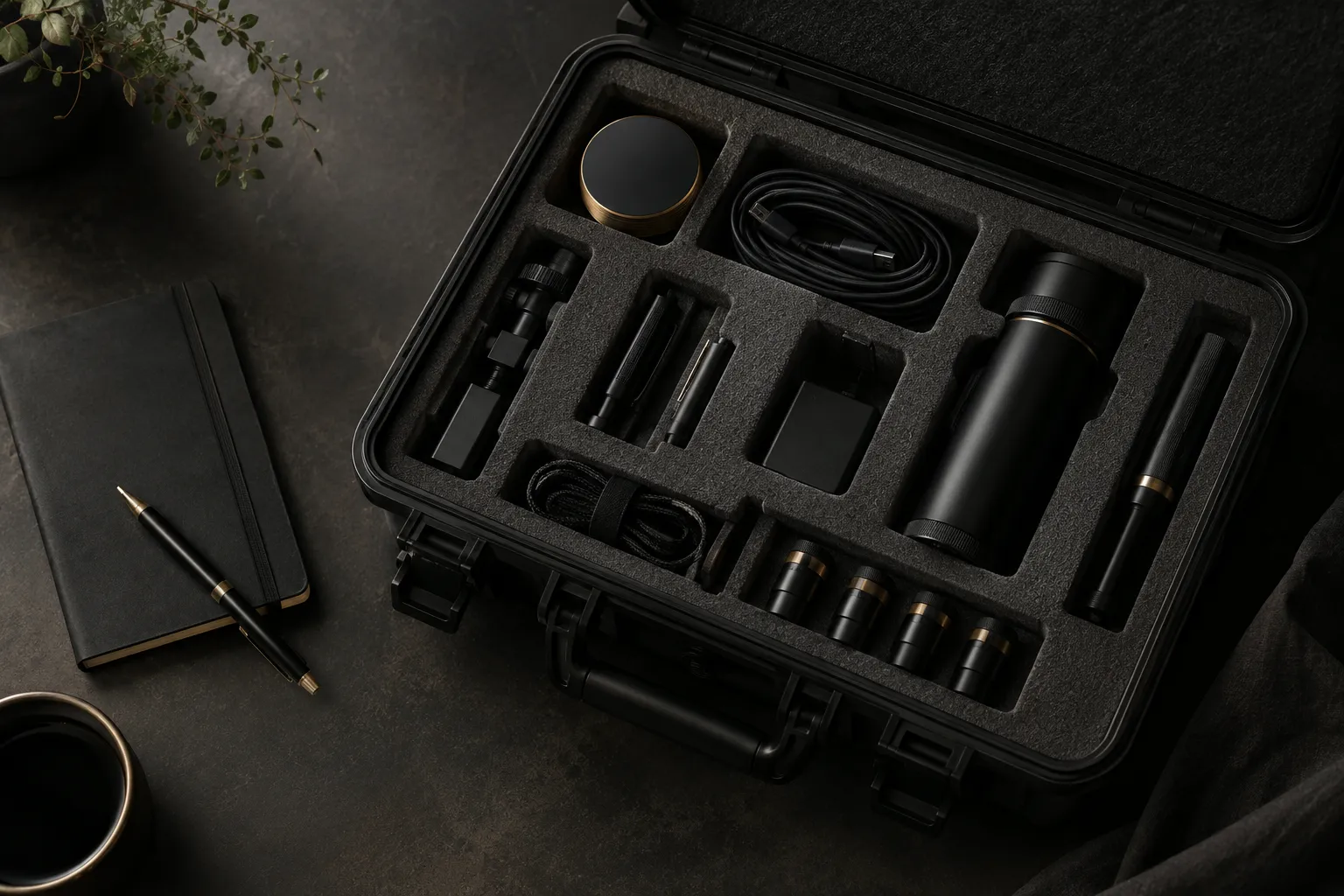
Airbnb & VRBO Home Security: Professional Counter-Surveillance for Ontario Homeowners (2026)
By Imperial Consulting Unit Inc. · Licensed PI · TSCM Certified
Airbnb & VRBO Home Security: Professional Counter-Surveillance for Ontario Homeowners (2026)
Ontario's short-term rental market has grown into one of the largest in Canada — more than five thousand homeowners across Toronto, Ottawa, Hamilton, and surrounding regions now list their properties on Airbnb and VRBO. Guest self-check-in, keypad codes, and unsupervised home access have created a threat model that simply did not exist a decade ago. In 2026, the question is no longer whether your property carries surveillance risk — it is whether you have the professional documentation to prove you addressed it before something went wrong.
No Ontario TSCM provider publishes a dedicated guide for Airbnb and VRBO homeowners. Every competitor focuses on hotel chains, corporate boardrooms, and executive vehicles. That gap leaves individual hosts — the people with the most to lose — without credible guidance. This post fills that gap. If you are an Ontario host managing one property or a small portfolio, understanding what TSCM actually involves is the first step toward protecting your guests, your insurance, and your Airbnb account status.
Pricing is custom — quoted privately after a confidential consultation. Every sweep engagement starts with a brief intake call to understand your property type, booking frequency, and risk profile before any figure is discussed.
Why Ontario Airbnb & VRBO Hosts Need Professional TSCM Before Every Booking Season
The residential short-term rental model introduces surveillance risks that professional security has never encountered at scale before 2026. A hotel guest accesses a single room with a keycard that deactivates on checkout. An Airbnb guest receives a personal keypad code that may persist, gains access to your kitchen, living room, bathroom, laundry, and garage, and in many cases stays in a property while you are entirely absent for the duration of their visit.
That physical access creates a window for device placement that hotel security staff would intercept immediately. At a residential property, there is no front desk, no security patrol, and no key return process. Guests who arrive with harmful intent — whether stalking a co-guest, collecting intelligence on homeowner routines, or placing recording equipment for blackmail — operate without any deterrent between check-in and checkout.
The 2026 booking season has coincided with a documented rise in guest-planted hidden camera incidents, AirTag-based stalking reports, and WiFi network compromises traced to short-term rental stays. Ontario hosts who complete a recurring TSCM membership sweep before each booking season carry professional documentation confirming their property was clean at a specific date — a critical protection when a guest complaint triggers an Airbnb investigation or an insurance claim adjuster demands evidence of due diligence.
The 8-Point Guest Privacy Threat Assessment for Short-Term Rental Homeowners
The Imperial Consulting Unit residential threat assessment is structured around eight documented risk vectors specific to short-term rental properties. Each represents a distinct attack surface that differs materially from commercial or hotel TSCM work.
Eight Documented Risk Vectors
| # | Threat Vector | Method | Detection Approach |
|---|---|---|---|
| 1 | Keypad code capture at front door | Guest installs covert camera at entry to record PIN for unauthorized return | Physical inspection of doorframe, porch fixtures, neighbouring surfaces; RF scan for transmitting devices |
| 2 | Listening device in common areas | Guest places audio recorder or spy camera in living room, kitchen, or dining area before checkout | NLJD sweep of furniture, decorative items, plant pots, smoke detector housings |
| 3 | Home WiFi network compromise | Tech-savvy guest installs rogue access point or network monitoring device to intercept host communications post-departure | WiFi audit of connected device inventory; scan for unauthorized access points on 2.4 GHz and 5.8 GHz bands |
| 4 | Smart home eavesdropping via Alexa or Google Home | Guest enables hidden microphone permissions or installs third-party spy app before departure | Smart home device audit — permissions review, account access log, linked app verification |
| 5 | Bathroom hidden cameras | Stalking-intent guest embeds camera in smoke detector, outlet cover, clock radio, or showerhead fixture | RF spectrum analysis; NLJD scan of smoke detectors, outlets, and all fixtures; thermal imaging of electronic devices concealed in walls |
| 6 | Bedroom eavesdropping via pinhole cameras | Guest targets high-value bookings or stalks co-guests via camera concealed in ventilation grilles, wall outlets, or picture frames | Physical inspection of headboard area, bedside tables, wall-mounted décor; NLJD scan of all electrical outlets |
| 7 | Personal belongings tracking via Bluetooth | Guest plants AirTag in homeowner's purse, vehicle keys, or work bag for post-stay tracking | Bluetooth scan of all personal item storage areas; detection sweep of garage and vehicle access points — see also our guide to detecting GPS trackers on Ontario vehicles |
| 8 | Post-checkout planted surveillance devices | Guest deliberately leaves recording device to monitor future guests or document homeowner movements over subsequent weeks | Full-property post-checkout sweep; RF spectrum + NLJD + thermal imaging before next booking window opens |
Each of these threat vectors requires a different detection instrument and protocol. A consumer-grade RF detector purchased online addresses at most one or two transmission frequencies. A professional sweep addresses all eight simultaneously, with chain-of-custody documentation that holds up in an insurance claim, a police report, or an Airbnb resolution dispute.
Residential Airbnb TSCM vs. Hotel TSCM: Why the Threat Models Differ
Hotel TSCM — which ICUnit also provides for Ontario resorts and lodge operators — is structured around professional staff presence, multi-room coordination, 24-hour security coverage, and guest room access controlled by electronically logged keycards. The threat model for a 200-room hotel property is operationally distinct from a two-bedroom Airbnb in North York or a four-bedroom waterfront rental in Kingston.
Residential Airbnb properties carry vulnerabilities that hotels structurally eliminate: guest self-check-in without human verification, unrestricted access to homeowner personal documents and private storage areas, shared facilities that rotate between strangers every two to five days, and an absent host who cannot conduct a visual inspection between stays. The buyer persona for residential TSCM is also distinct — individual homeowners and small portfolio managers operate on a three-to-seven-day decision window before each booking cycle, not a two-to-four-week procurement committee process.
Our office bug sweep methodology shares underlying detection instruments with residential TSCM, but the physical inspection protocol, threat prioritization, and documentation format are built for residential properties, Airbnb platform compliance reporting, and homeowner insurance underwriting — not corporate security policy.
Pre-Listing Security Sweep: What ICUnit Checks Before Your First Guest Arrives
A pre-listing sweep is the foundation of a defensible Airbnb security posture. The Imperial Consulting Unit inspection protocol for short-term rental properties covers seven zones in sequence:
Seven-Zone Residential Inspection Protocol
- Entry & exterior: Front door keypad housing, doorbell camera review, porch fixtures, mailbox, exterior light fixtures. Door sensor inspection to detect unauthorized recording of entry and exit patterns. Smart lock access log review for anomalous entries.
- Living room & common areas: Furniture cushion inspection, television stand and bookshelf sweeps, RF scan of all surfaces above and below sightlines, NLJD sweep of decorative items, plant pots, and smoke detectors.
- Kitchen: Under-counter inspection for voice recorders, appliance vent sweeps, refrigerator and dishwasher housing inspection. WiFi-connected appliance audit for unauthorized linked accounts.
- Bedrooms: Headboard, bedside lamp base, wall outlet NLJD scan, picture frame inspection, closet upper shelf and clothing rod inspection, ventilation grille check.
- Bathrooms: Soap dispenser, toothbrush holder, exhaust ventilation duct, mirror backing, shower fixture housing, outlet cover inspection. Thermal imaging of wall surfaces for concealed electronics.
- Smart home audit: Full inventory of WiFi-connected devices, Alexa and Google Home permissions review, Ring camera account settings, smart lock access history, rogue access point detection on 2.4 GHz and 5.8 GHz bands.
- Basement, attic & garage (if guest-accessible): Electrical outlet inspection, WiFi router physical tamper check, vehicle keyless entry vulnerability scan, personal belongings storage area AirTag sweep.
The inspection generates a written report formatted for three audiences: Airbnb platform escalation, homeowner insurance underwriting, and municipal short-term rental licensing compliance. The home office sweep component is included at no additional scope when the homeowner operates a business from the same property — a common scenario for remote-working Ontario hosts.
For hosts managing multiple properties or booking year-round, the recurring TSCM membership plan provides quarterly inspection access, emergency same-day dispatch, and annual documentation packages formatted for insurance and licensing renewal. Pricing is custom — quoted privately after a confidential consultation.
Ontario Short-Term Rental Licensing & Guest Privacy Disclosure Requirements (2026)
Toronto introduced short-term rental registration in 2019, imposing a principal residence requirement, an annual listing limit, and mandatory guest safety standards. Ottawa followed with its own registration framework in 2021. Hamilton adopted short-term rental rules in 2023. As of 2026, municipal licensing authorities in Peel, York, Durham, and Halton regions are advancing toward similar registration and disclosure requirements.
Under Toronto's short-term rental bylaws, hosts are required to disclose known safety hazards and maintain the property to guest safety standards. A professional TSCM sweep report creates a positive disclosure record — evidence that a licensed operator actively confirmed the absence of surveillance devices before each booking period. This documentation strengthens licensing renewal applications and positions your listing as higher trust on the Airbnb platform itself.
Ontario's Consumer Protection Act also prohibits deceptive practices, which extends to non-disclosure of known safety hazards to paying guests. A homeowner who discovers a surveillance device and fails to disclose it — or who was negligent in detecting one — faces civil liability under the guest's right to privacy and safety. A pre-listing TSCM sweep is the most direct mitigation available under Ontario law in 2026.
Homeowner Insurance & Liability: How TSCM Documentation Protects Your Coverage
Standard homeowner liability policies may exclude guest injury claims where property security negligence can be demonstrated. When an Airbnb guest files a claim alleging that a surveillance device was present during their stay, the insurer's claims adjuster must determine whether the device was planted by a previous guest or was known to — or ignored by — the homeowner. Without a pre-listing TSCM report, the adjuster has no objective baseline.
A professionally documented sweep, conducted before the booking period in question, creates the evidentiary chain that confirms the property was clean at a specific date. Short-term rental specialty insurers — including those who underwrite Airbnb host liability coverage — increasingly require TSCM documentation as a condition of claim validation or coverage expansion. Hosts who maintain quarterly sweep records through a TSCM membership demonstrate a continuous duty-of-care posture rather than a reactive response to a specific incident.
The Office of the Privacy Commissioner of Canada has issued guidance confirming that unauthorized recording of individuals in residential settings constitutes a serious privacy breach with potential criminal liability under the Criminal Code. That liability does not fall exclusively on the guest who planted the device — a homeowner who failed to detect and remove it may share exposure under negligence doctrine. Professional TSCM documentation is your evidence that you took reasonable steps.
The office and residential bundle package combines a full home sweep with vehicle counter-surveillance in a single engagement — particularly useful for hosts who use their vehicle for work and whose vehicle keyless entry is accessible from the same garage a guest can access.
Airbnb Terms of Service Compliance & Platform Accountability for Ontario Hosts
Airbnb's host terms of service require disclosure of known safety hazards, maintenance of property safety standards, and cooperation with law enforcement investigations. An undisclosed surveillance device — regardless of who planted it — constitutes a material breach of those terms, with potential consequences including account suspension, forced guest refunds, and civil liability for privacy invasion.
In 2026, Airbnb's expanded safety initiatives have increased scrutiny of host properties following guest safety complaints. A host who can produce a dated, professionally certified TSCM report within 48 hours of a complaint has a materially stronger position in the Airbnb resolution process than a host who cannot. The ICUnit Airbnb platform compliance report is formatted specifically for Airbnb support escalation — it is structured to address the platform's internal investigation criteria, not just the general standards of a commercial security sweep.
Emergency Response Protocol After Guest Checkout Discovery
When a guest leaves a suspicious device — or when you discover something during a routine inspection after checkout — the sequence of actions in the first 24 hours determines whether you will have usable evidence for a police report, an insurance claim, and an Airbnb resolution submission.
- Photograph the device in place using a ruler for scale before touching anything. Preserve exact location, orientation, and surrounding context.
- Secure the property immediately: change keypad code, verify all door locks, scan WiFi for new unauthorized access points.
- Contact ICUnit within 24 hours for emergency response dispatch. Same-day service is available across Ontario. Request an emergency sweep here — our team responds to short-term rental incidents with priority scheduling.
- Preserve the device without handling it further. Place a glass over it if it is small. Maintain chain of custody for police submission.
- File a police report if the device indicates criminal intent — recording devices and stalking cameras trigger Criminal Code sections on unauthorized interception and voyeurism.
- Contact Airbnb support to document the incident and request guest deactivation. Attach your ICUnit emergency report once it is completed.
- Notify your insurance broker and initiate a claim investigation if guest privacy liability is implicated.
- Contact the municipal licensing authority (Toronto, Ottawa, or Hamilton, as applicable) to confirm your disclosure obligations under the relevant short-term rental bylaw.
Emergency sweep pricing is custom and quoted on intake based on property size, location, and urgency of dispatch. Pricing is custom — quoted privately after a confidential consultation.
Why Choose Imperial Consulting Unit for Your Airbnb Counter-Surveillance?
Our founder's credentials — reviewed in full at our About page — include Canadian Armed Forces veteran service, a PSISA-licensed Private Investigator designation under Ontario's Private Security and Investigative Services Act 2005, MESA RF Certification, and TSCM Certification. That combination of regulatory licensing and technical certification is rare in the Ontario residential security market and directly relevant to Airbnb TSCM work: PI licensing governs the evidentiary handling of surveillance findings; MESA RF Certification validates the spectrum analysis methodology; TSCM Certification covers the physical inspection and non-linear junction detection protocols.
Imperial is currently the only Ontario TSCM provider publishing a dedicated residential Airbnb and VRBO counter-surveillance framework. Every other licensed provider in the province focuses on hotel chains, corporate boardrooms, and executive vehicle fleets. Our homeowner-specific threat model — built around guest self-check-in liability, keypad code security, smart home integration risks, and short-term rental licensing compliance — addresses the exact vulnerabilities that generic commercial TSCM misses.
"I found a small device behind the bedside lamp after a long-term guest checked out of my North York property in spring 2026. ICUnit was on-site within six hours. The chain-of-custody report they produced was exactly what my insurance adjuster and the police detective both asked for. I would not have known what to photograph or how to preserve the evidence without their guidance."
— Verified ICUnit client, North York, 2026
The vehicle GPS sweep service is frequently added to Airbnb homeowner engagements when hosts discover that their garage was accessible during a guest's stay — a common scenario in properties where guest parking is included in the listing.
Service Areas: Ontario Airbnb & VRBO Homeowners We Serve
ICUnit deploys across Ontario on a mobile basis from our Greater Toronto Area base. Standard service areas for Airbnb and VRBO homeowner sweeps include:
- Toronto & GTA: Toronto (highest concentration of licensed STR properties; Toronto City Hall STR registration mandatory since 2019), Mississauga, Brampton, Vaughan, Markham, Richmond Hill, Oakville, Burlington, Scarborough, North York, Etobicoke
- Ottawa & Eastern Ontario: Ottawa (mandatory STR registration since 2021; Airbnb host density concentrated in Byward Market and Centretown), Kingston
- Hamilton & Niagara: Hamilton (short-term rental bylaw adopted 2023), Niagara Falls (high tourist-season booking volume, elevated guest-turnover risk)
- Barrie & cottage country: Barrie, Aurora, Newmarket — significant Airbnb density driven by weekend cottage rental traffic
- London & Kitchener-Waterloo: University-adjacent STR market; property manager portfolio engagements common
Emergency response is available province-wide. Travel surcharges for locations beyond 150 km of our GTA base are quoted on intake.
Frequently Asked Questions: Airbnb Counter-Surveillance for Ontario Homeowners
What devices do TSCM professionals look for during an Airbnb pre-listing sweep?
A professional pre-listing sweep searches for RF-transmitting devices (hidden cameras and audio recorders that broadcast over WiFi, Bluetooth, or cellular), non-transmitting recording devices (SD card cameras that store locally), NLJD-detectable semiconductor components (pinhole cameras embedded in fixtures), rogue WiFi access points installed by a previous guest, smart home permission anomalies (Alexa or Google Home accounts linked without authorization), and Bluetooth proximity trackers (AirTags or Tile devices planted in personal storage areas). Consumer-grade RF detectors sold online address at most one frequency range. A certified sweep addresses the full threat spectrum across all eight documented risk vectors.
How often should Ontario Airbnb hosts schedule counter-surveillance inspections?
Hosts managing year-round properties in high-volume markets (Toronto, Ottawa, Niagara) benefit from quarterly sweeps — one before each seasonal booking peak. The ICUnit TSCM membership plan provides four scheduled sweeps per year plus emergency same-day access between scheduled visits. Hosts managing properties with lower annual occupancy typically schedule one pre-season sweep and one post-season sweep, with emergency access for post-checkout concerns. Pricing is custom — quoted privately after a confidential consultation.
What should I do if I find a suspicious device after a guest checks out of my Ontario Airbnb?
Photograph the device in place with a ruler for scale before moving it. Secure the property — change keypad codes and scan for new WiFi access points. Contact ICUnit for emergency documentation within 24 hours. Do not handle the device further — preserve chain of custody for police submission. File a report with your local police service if the device indicates criminal intent (recording camera, audio transmitter). Contact Airbnb support and attach your ICUnit emergency sweep report once issued. Notify your homeowner insurance broker to initiate a claim investigation.
Does homeowner insurance require TSCM documentation for Airbnb liability coverage in Ontario?
Specialty short-term rental insurers increasingly require professional TSCM documentation as a condition of claim validation — particularly in guest privacy breach scenarios where the insurer must distinguish between a homeowner-planted device and a guest-planted device. Standard homeowner policies may exclude guest injury claims where negligence in property security maintenance can be demonstrated. A pre-listing sweep report, maintained as a dated record before each booking period, creates the evidentiary baseline that claims adjusters require. Pricing is custom — quoted privately after a confidential consultation.
Is a TSCM sweep required for Toronto's short-term rental licensing application?
Toronto's current STR licensing framework does not mandate a professional TSCM sweep as a specific condition of registration. However, hosts are required to disclose known safety hazards and maintain the property to guest safety standards — obligations that a documented TSCM sweep directly supports. As of 2026, Toronto, Ottawa, and Hamilton all enforce short-term rental registration with guest safety disclosure requirements. Hosts who maintain TSCM records strengthen their licensing renewal applications and carry a defensible position under the Ontario Consumer Protection Act's deceptive practices provisions.
What is the difference between an Airbnb homeowner sweep and a hotel TSCM sweep?
Hotel TSCM focuses on multi-room coordination, professional staff-supervised access control, executive suite and boardroom confidentiality, and 24-hour on-site security presence. Airbnb homeowner TSCM focuses on guest self-check-in liability (keypad code capture risk), personal item storage vulnerability (AirTag planting in homeowner belongings), smart home device audit (Alexa and Google Home permission anomalies), single-property recurring inspections, and documentation formatted for Airbnb platform compliance and homeowner insurance underwriting. The detection instruments overlap — RF spectrum analysis, NLJD, thermal imaging — but the threat model, inspection protocol, and output report are built for residential short-term rental use cases, not commercial hospitality.
Can a professional TSCM sweep detect an AirTag planted by a guest?
Yes. AirTags and similar Bluetooth proximity trackers (Tile, Samsung SmartTag) are detectable through a Bluetooth frequency scan and physical inspection of personal item storage areas — purses, jacket pockets, vehicle key hooks, laptop bags, and travel luggage left at the property. ICUnit sweeps include a dedicated Bluetooth tracker detection protocol for all personal belonging storage zones. For vehicle-access properties where guest parking is included, a vehicle counter-surveillance component covers OBD-II port devices and magnetic tracker attachment points. See also: how to detect a GPS tracker on your Ontario vehicle.
Stay Connected
Follow the ICUnit field log on LinkedIn for new Ontario threat intelligence and short-term rental security advisories, and read our Google reviews from verified sweep clients across the province.
Get Your Free Quote Today
Ontario Airbnb and VRBO homeowners carry a guest privacy liability that no other property type matches — unrestricted residential access, absent-host stays, and shared personal spaces create a unique counter-surveillance requirement that generic commercial TSCM does not address. Imperial Consulting Unit is the only Ontario TSCM provider with a documented residential short-term rental threat model, Airbnb platform compliance report format, and homeowner insurance underwriting documentation package.
Whether you are preparing for your first listing, managing a portfolio of properties, or responding to a post-checkout discovery, book a confidential consultation to discuss your property's specific risk profile.
Call: 905-955-7689