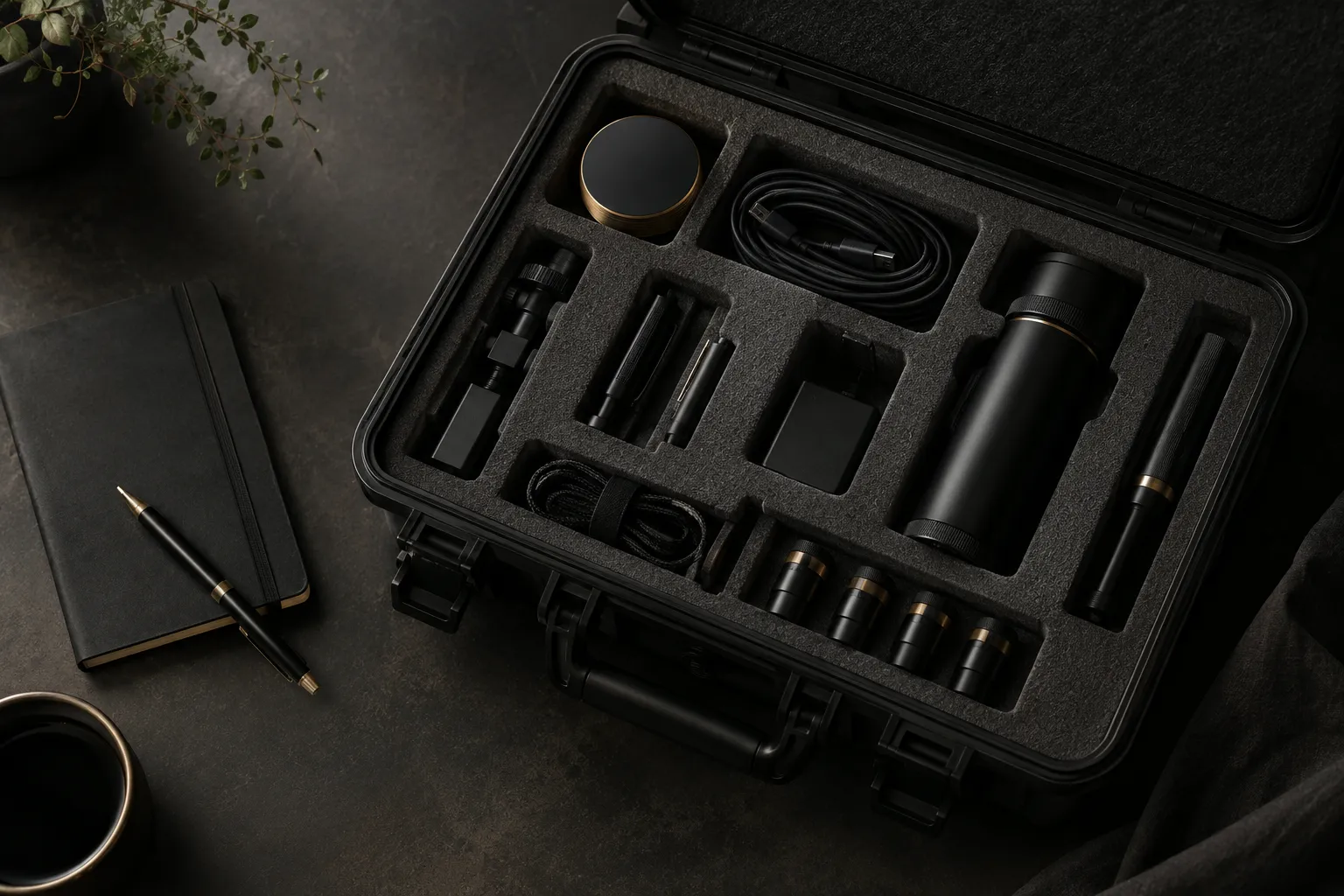
Law Firm Boardroom Surveillance Detection: Attorney-Client Privilege & Litigation Support (2026)
By Imperial Consulting Unit Inc. · Licensed PI · TSCM Certified
Law Firm Boardroom Surveillance Detection: Attorney-Client Privilege & Litigation Support (2026)
A managing partner at a Toronto Bay Street firm discovered the hard way that a confidential M&A negotiation — months of preparation, tens of millions in deal value — had been overheard by a competitor. A listening device, concealed in the boardroom's HVAC vent, had been transmitting audio for six weeks before discovery. The breach triggered a regulatory inquiry, cost the firm a key client relationship, and generated significant malpractice exposure. A professional TSCM sweep, conducted before the opposing counsel's facility visit, would have detected the device before a single sensitive word was spoken.
Ontario law firms face a convergence of boardroom threats in 2026: corporate espionage from competitors, insider risks from departing lateral hires, and spousal surveillance planted during high-conflict family law matters. This guide explains what professional boardroom TSCM involves for Ontario law practices, how Evidence Act RSO 1990 chain-of-custody protocols protect litigation admissibility, and why PSISA-licensed expert witness capability transforms a standard bug sweep into a litigation-grade asset for your firm.
Ready to protect your boardroom? Book a confidential consultation with ICUnit — discreet, PSISA-licensed, mobile across Ontario.
Why Ontario Law Firms Are Prime Targets for Boardroom Surveillance
Law firm boardrooms concentrate the most commercially sensitive verbal communications in the province: unreported M&A terms, litigation strategy sessions, settlement negotiations, witness preparation discussions, and direct attorney-client conversations protected by privilege. That density of high-value, non-recorded intelligence makes law firms disproportionately attractive targets for surveillance operations.
Documented threat scenarios in Ontario law firm settings include: competitors planting listening devices in conference rooms during opposing counsel visits, disgruntled associates recording partnership meetings before departing for rival firms, litigants seeking advance knowledge of opposing trial strategy, and in family law matters, abusive ex-partners placing listening devices in client boardrooms to monitor custody and settlement strategy sessions.
Unlike general corporate offices, a compromised law firm boardroom creates cascading privilege consequences. Discovery of surveillance may trigger solicitor disclosure obligations. Evidence of what was overheard may be weaponized in ongoing or future proceedings. And failure to implement reasonable counter-surveillance due diligence may itself become the basis for a malpractice claim.
For a baseline overview of commercial counter-surveillance indicators, ICUnit's office bug sweep detection guide covers the foundational threat landscape applicable to any corporate environment, including law firm settings.
Ontario Legal Framework: Evidence Act RSO 1990, Criminal Code 184.1 & PSISA Act 2005
Three statutes define the legal architecture around law firm boardroom TSCM in Ontario:
Evidence Act RSO 1990 establishes expert admissibility criteria for Ontario courts. TSCM evidence — device recovery, RF spectrum logs, chain-of-custody documentation — is admissible when: (a) the expert witness holds established qualifications including PSISA licensing and prior courtroom experience, (b) the detection methodology is explained under cross-examination, (c) an unbroken chain of custody runs from discovery through to submission, and (d) no evidence contamination occurred during handling. PSISA-unlicensed operators cannot serve as expert witnesses; their findings risk inadmissibility, creating mistrial exposure in criminal proceedings and evidentiary gaps in civil litigation.
Criminal Code s.184.1 makes unauthorized surreptitious recording of private communications an indictable offence, carrying a maximum five-year imprisonment sentence. When a TSCM sweep discovers a listening device in a law firm boardroom, the discovery triggers police coordination obligations for criminal evidence preservation. Handling evidence improperly at this stage — moving a device without documentation, photographing without timestamps, or allowing unauthorized access to the sealed device — can destroy the prosecution case. See the Criminal Code of Canada, Department of Justice for the full text of s.184.
PSISA Act 2005 (Ontario) requires private investigators to hold a valid licence when performing investigations and providing testimony in Ontario courts. ICUnit's PSISA licensing means our operators are qualified to serve as expert witnesses in Ontario Superior Court, Family Court, and criminal proceedings — a credential that directly governs evidence admissibility in 2026 Ontario proceedings. The Private Security and Investigative Services Act, 2005 governs this licensing framework.
TSCM Threat Landscape for Law Firms: Insider Threats, Competitors & Spousal Surveillance
Law firm boardroom threats in 2026 fall into four operationally distinct categories:
Competitive intelligence operations: A competitor plants a listening device — typically concealed in a conference room telephone, charging station, wall clock, or ceiling tile — before or during an opposing counsel visit, building maintenance window, or after-hours access by a compromised contractor. M&A deal terms, litigation settlement positions, and client retention strategy are the primary intelligence targets.
Insider threats from departing personnel: Disgruntled associates or exiting partners may install recording devices before departure to capture partnership communications, compensation data, or client development strategies for use at a competitor firm. Devices are frequently placed in boardrooms, partner offices, and informal break room spaces where privilege-sensitive conversations occur outside of formal meeting protocols.
Spousal surveillance in family law matters: Adverse parties in high-conflict divorce proceedings have been documented planting listening devices in family law firm conference rooms to monitor attorney-client strategy sessions and deposition preparation. This creates both an evidentiary problem — privileged communications overheard by an adverse party — and direct criminal liability exposure under Criminal Code s.184.1. ICUnit's vehicle GPS sweep service is also relevant where spousal surveillance extends to tracking an attorney's or client's movements between office and courthouse.
Foreign intelligence targeting: For firms engaged in cross-border M&A, regulatory matters, or government relations work involving foreign state-owned enterprises, the threat profile may extend to foreign intelligence service activity. This is the highest-sophistication threat tier, requiring NLJD-level detection capability beyond consumer RF detection tools.
ICUnit's guide to corporate espionage warning signs covers early behavioural and technical indicators applicable to law firm environments.
Commissioning TSCM Through Counsel: Preserving Attorney-Client Privilege in Your Investigation
The most consequential risk-management decision a law firm makes when commissioning a TSCM investigation is who retains the investigator. The distinction is legally significant.
When a law firm's managing partner or office administrator retains ICUnit directly, the resulting TSCM report may be discoverable in subsequent litigation. When outside counsel or in-house legal counsel retains ICUnit as a litigation support investigator, the engagement and resulting report typically fall within attorney-client privilege as work product — protected from production in opposing party discovery requests.
This distinction matters acutely in three specific scenarios: (1) the firm is anticipating litigation arising from a confirmed surveillance breach, (2) the firm is conducting internal due diligence that may become relevant to a regulatory inquiry, and (3) the firm is investigating a suspected insider threat that may lead to employment or wrongful dismissal proceedings.
ICUnit operates within counsel-retained investigation frameworks, providing privileged-format reporting to retaining counsel for onward communication to the firm partnership. This preserves the privilege chain while delivering fully actionable TSCM findings and court-ready documentation.
Professional Detection Methods: NLJD, RF Spectrum Analysis & Thermal Imaging
ICUnit's law firm boardroom TSCM protocol employs four complementary detection methodologies consistent with 2026 MESA RF certification standards. No single method alone provides adequate coverage for a professional law firm environment:
Non-Linear Junction Detection (NLJD): Detects semiconductor junctions — transistors, integrated circuits, and microchips — concealed within construction materials, furniture, fixtures, and walls. NLJD identifies passive listening devices that are not currently transmitting and would therefore escape RF spectrum detection entirely. Critical for detecting dormant devices that activate on a timer, voice command, or when a specific Bluetooth or Wi-Fi signal is present.
RF Spectrum Analysis: A calibrated broadband receiver scans the frequency environment from low MHz through GHz ranges, identifying anomalous transmissions consistent with listening devices, GSM audio transmitters, Wi-Fi microphones, and covert cameras. ICUnit's recurring TSCM membership establishes a baseline RF signature for each client location, allowing each subsequent quarterly sweep to detect new transmission anomalies immediately against a documented frequency baseline.
Thermal Imaging: Electronic devices generate heat. Thermal imaging identifies heat signatures inconsistent with the installed building infrastructure — a wall outlet drawing current when the circuit should be dormant, or a ceiling tile concealing a powered device package.
Physical Inspection Protocol: Every furniture piece, wall plate, power outlet, ceiling tile, telephone handset, conference room AV system component, and HVAC vent is physically examined. Battery-powered devices not transmitting during the sweep window are identified at this stage. ICUnit's Office TSCM Sweep covers all four detection layers in a single engagement.
For a full technical explanation of TSCM methodology, see ICUnit's What is TSCM? guide.
Chain-of-Custody Protocols for Court-Admissible TSCM Evidence
When a sweep discovers a surveillance device, the handling procedure from discovery onward determines whether the evidence supports criminal prosecution, civil damages claims, or insurance documentation. Improperly handled evidence — moved without documentation, photographed without timestamps, or accessed by unauthorized parties — is routinely challenged and excluded in Ontario proceedings.
ICUnit's chain-of-custody protocol includes:
- Discovery documentation: Timestamp photograph with synchronized clock visible in frame; location photograph showing boardroom layout with device position marked; undisturbed in-situ condition photograph before any handling.
- Immediate containment: Device sealed in a static-free evidence bag, labeled with date, time, discoverer's initials, and witness confirmation signature.
- Custody transfer log: Signed chain-of-custody form recording every handoff — from discovery operator to senior investigator, to police liaison, to retaining legal counsel.
- Secure storage: Locked cabinet with access log documenting every party who accessed the evidence, the date and time, and purpose.
- PSISA expert affidavit: Signed affidavit describing discovery protocol, detection methodology employed, and unbroken chain of custody — formatted for Ontario Superior Court admissibility.
This documentation package transforms a TSCM sweep from a security service into a litigation-grade evidentiary asset usable in criminal proceedings, civil damages actions, employment litigation, and insurance claim defense.
PSISA-Licensed Expert Witness: Why Court Qualification Is Non-Negotiable
Law firm counsel vetting a TSCM provider for litigation support should ask three qualifying questions: Is the operator PSISA-licensed under Ontario's Private Security and Investigative Services Act, 2005? Have they testified as an expert witness in Ontario courts? Can they provide a PSISA-signed expert affidavit in a format accepted by the Ontario Superior Court and Family Court?
ICUnit's founding operator holds PSISA licensing, MESA RF certification, TSCM certification, and brings a Canadian Armed Forces background in structured evidence handling and chain-of-custody discipline — all qualifications documented on the ICUnit About page. This combination of licensing credentials and military investigation methodology is what enables expert witness testimony in Ontario's most demanding proceedings.
Unlicensed TSCM operators — common in the Ontario market — cannot function as expert witnesses. Evidence they discover may be ruled inadmissible under the Evidence Act RSO 1990 expert qualification standard, creating a gap in prosecution or civil damages arguments at precisely the moment the evidence matters most. For law firms engaging TSCM in an active or anticipated litigation context, PSISA licensing is a non-negotiable selection criterion in 2026.
ICUnit's quarterly TSCM membership includes expert witness availability as part of the retainer relationship — ensuring that if a device is discovered during any scheduled sweep, litigation support is immediately available without a new qualification and engagement process.
D&O Insurance Documentation & Malpractice Coverage Implications
Law firm partnerships managing Directors and Officers coverage and professional malpractice insurance face a practical due diligence question following a surveillance breach: did the firm take reasonable steps to protect privileged communications prior to the incident?
A negative-finding TSCM report — one confirming no surveillance devices were detected — is an insurable asset. It documents that the firm exercised professional due diligence in protecting client confidences. A PSISA-signed expert affidavit attached to a firm's insurance file strengthens the firm's position if a malpractice claim follows a subsequent breach, establishing that documented counter-surveillance protocols were active at the time.
ICUnit's recurring TSCM membership program generates this documentation on a scheduled quarterly cycle, creating a continuous due diligence record aligned with annual insurance renewal timelines. LAWPRO and commercial malpractice insurers have increasingly factored documented security due diligence protocols into risk assessment for coverage renewals. Pricing is custom — quoted privately after a confidential consultation.
ICUnit Law Firm TSCM vs. Generic Providers: What the Comparison Reveals
| Capability | ICUnit | Generic TSCM Provider |
|---|---|---|
| PSISA Licensed (expert witness admissible) | ✓ Yes | Often unlicensed |
| Evidence Act RSO 1990 chain-of-custody protocol | ✓ Documented | Not formalized |
| Attorney-client privilege engagement framework | ✓ Available | Not offered |
| Criminal Code 184.1 police coordination | ✓ Structured | Ad hoc or absent |
| MESA RF Certified operator | ✓ Certified | Not disclosed |
| NLJD + RF spectrum + thermal + physical inspection | All four methods | RF detection only (common) |
| Expert witness testimony in Ontario courts | ✓ Available | Not qualified |
| Quarterly membership with documentation | ✓ Structured | One-time sweep only |
| PSISA-signed expert affidavit for insurance | ✓ Included | Not available |
| Law-firm-specific reporting for counsel | ✓ Privileged format | Generic security report |
Why Ontario Law Firms Choose ICUnit for Boardroom TSCM
Ontario law firms require a TSCM provider who understands that a boardroom sweep is not simply a security service — it is a legal and evidentiary function with privilege, admissibility, and insurance consequences that demand the same professional discipline as the matters discussed in those rooms.
ICUnit is the only Ontario TSCM provider publicly integrating attorney-client privilege engagement frameworks, PSISA-licensed expert witness testimony, Evidence Act RSO 1990 chain-of-custody protocols, Criminal Code 184.1 police coordination expertise, and structured law firm quarterly TSCM memberships with documentation formatted for D&O insurance and malpractice renewal files.
Our engagements span law firm partnerships, in-house legal teams at Ontario corporations, and private counsel handling high-conflict family law matters — all expecting that findings discovered in the boardroom are handled with the same documented rigour as the privileged communications they protect.
"After a trusted associate departed under difficult circumstances, our North York firm engaged ICUnit for a full boardroom and partner office sweep. Their chain-of-custody documentation and PSISA affidavit were formally referenced during subsequent employment litigation proceedings in 2026. We enrolled in the quarterly membership the same week."
— Managing Partner, Corporate Law Practice, North York, Ontario (2026)
ICUnit Service Areas: Toronto Law Firms, Ottawa Counsel & Across Ontario
ICUnit provides law firm boardroom TSCM across Ontario. Primary service areas for law firm engagements include:
Toronto — Bay Street corporate firms, Yonge-Bloor litigation practices, Midtown family law, and North York and Etobicoke regional law offices. Toronto law firm boardroom sweeps are available with priority scheduling.
Ottawa — Federal regulatory counsel, government relations practices, Parliamentary law firms, and national security-adjacent legal advisors with elevated foreign intelligence threat exposure.
Additional Ontario coverage includes Hamilton, Mississauga, Brampton, Markham, Vaughan, Kitchener-Waterloo, London, Barrie, Kingston, and Niagara region. For multi-location firms, ICUnit's Office TSCM Sweep and recurring quarterly membership can be structured across a rotating location schedule covering your full Ontario footprint. An Office and Vehicle bundle package is available for managing partners requiring combined boardroom and personal vehicle sweeps in a single engagement.
Frequently Asked Questions — Law Firm Boardroom TSCM Ontario
What is boardroom TSCM and why do Ontario law firms need it in 2026?
TSCM (Technical Surveillance Countermeasures) is a structured methodology for detecting hidden electronic surveillance devices — listening devices, covert cameras, GSM audio transmitters — in sensitive spaces. Ontario law firms require boardroom TSCM because conference rooms, partner offices, and client meeting spaces host the most commercially sensitive verbal communications in the province. In 2026, commercially available covert audio devices — including voice-activated GSM transmitters and dormant passive recorders — have significantly lowered the technical barrier for surveillance attacks. A single undetected device in a boardroom can compromise months of privileged work product and trigger both criminal liability under Criminal Code 184.1 and malpractice exposure.
Can TSCM evidence be admitted in Ontario Superior Court proceedings?
Yes — when collected by a PSISA-licensed operator following Evidence Act RSO 1990 chain-of-custody protocols. The expert witness must hold current PSISA licensing, their detection methodology must be testimonially defensible under cross-examination, and the custody documentation must be unbroken from discovery through to court submission. ICUnit's PSISA licensing and structured chain-of-custody protocol are specifically designed to meet Ontario Superior Court, Family Court, and criminal proceeding admissibility standards. Evidence collected by unlicensed operators or with contaminated custody chains risks inadmissibility, creating gaps in prosecution and damages arguments at the critical moment.
Does commissioning TSCM through our legal counsel protect the investigation from discovery?
When outside counsel or in-house legal counsel retains ICUnit as a litigation support investigator, the engagement typically falls within attorney-client privilege as work product, protecting the TSCM report from production in opposing party discovery requests. When firm administration retains directly — not through counsel — the report may be discoverable. For any firm anticipating litigation arising from a surveillance breach, commission through counsel is the recommended approach. ICUnit is experienced in operating within counsel-retained investigation frameworks, delivering privileged-format reporting directly to retaining counsel.
What happens immediately after a device is discovered during a boardroom sweep?
ICUnit follows a structured post-discovery protocol: the device is photographed in situ with timestamped documentation (clock in frame), sealed in a static-free evidence bag with a signed chain-of-custody form, and the client's retaining legal counsel is notified immediately. Police coordination — OPP or Toronto Police Service depending on jurisdiction — is initiated for Criminal Code 184.1 criminal evidence preservation. ICUnit's PSISA-signed expert affidavit documents the discovery protocol for criminal prosecution, civil litigation, or D&O insurance claim purposes. The firm's counsel directs privilege strategy from the point of police referral onward.
How often should a law firm schedule boardroom TSCM sweeps?
Quarterly sweeps — four per year — are the standard recommendation for active law firms with ongoing sensitive matters. High-risk scheduling triggers include: before and after opposing counsel visits to firm premises, following any facility maintenance, renovation, or after-hours contractor access, after significant employee departures, and prior to major transaction closings or trial commencements. ICUnit's recurring TSCM membership provides scheduled quarterly sweeps with rolling documentation suitable for D&O insurance and malpractice coverage renewal files. Pricing is custom — quoted privately after a confidential consultation.
What devices can a professional TSCM sweep detect that consumer detectors miss?
A properly conducted sweep using NLJD, RF spectrum analysis, thermal imaging, and physical inspection can detect: GSM and 4G audio transmitters, Wi-Fi microphones, Bluetooth listening devices, passive non-transmitting recording devices, covert pinhole cameras, GPS trackers embedded in room fixtures, and anomalous electrical draws from modified wall outlets or AV equipment. Consumer RF detectors sold online typically detect only actively transmitting devices — entirely missing dormant, passive, and frequency-hopping devices that only professional NLJD and calibrated RF spectrum analysis will identify. In a law firm environment, relying on consumer-grade detection tools creates a false-security exposure that is operationally more dangerous than conducting no sweep at all.
Stay Connected
Follow the ICUnit field log on LinkedIn for new Ontario threat intelligence and law firm security updates, and read our Google reviews from past sweep clients across the GTA and Ontario.
Get Your Free Quote Today
Ontario law firms face real and documented boardroom surveillance threats in 2026. A PSISA-licensed, MESA RF Certified, Evidence Act-compliant TSCM sweep is the only way to confirm your boardroom is clean — and the only way to generate litigation-grade documentation if it is not.
ICUnit is discreet, licensed, and mobile across Ontario. We serve Toronto Bay Street firms, Ottawa regulatory counsel, and law practices across the province. Pricing is custom — quoted privately after a confidential consultation.
Call: 905-955-7689
Or request a boardroom sweep quote using our confidential intake form. Your inquiry is handled with full attorney-client discretion.