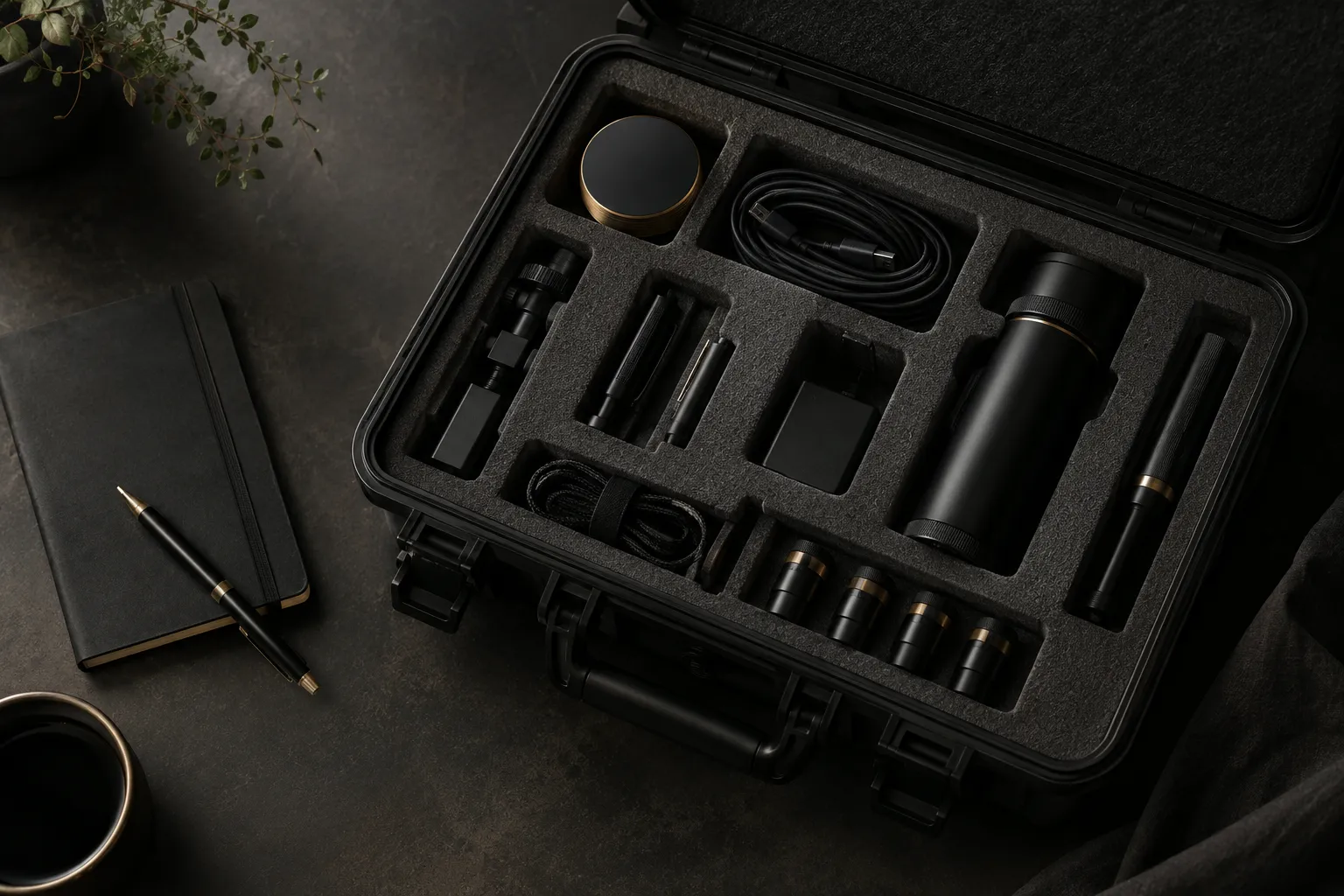
Executive Counter-Surveillance for M&A: TSCM Boardroom Sweep Before Merger Close (2026)
By Imperial Consulting Unit Inc. · Licensed PI · TSCM Certified
Executive Counter-Surveillance for M&A: TSCM Boardroom Sweep Before Merger Close (2026)
A nine-figure acquisition closes in forty-eight hours. The boardroom is set, outside counsel is en route, and your General Counsel has spent six weeks negotiating a valuation that no one outside the deal team should know. What nobody has checked is whether that boardroom is clean. In 2026, undetected surveillance during Ontario merger negotiations is no longer a theoretical risk — it is a documented vector for competitive intelligence leaks, insider trading investigations, and post-close litigation that can unwind years of deal work.
Imperial Consulting Unit's TSCM-certified, PSISA-licensed investigators specialize in executive counter-surveillance for active deal timelines — from confidential data-room preparation through final signing logistics. Our team deploys RF spectrum analysis, non-linear junction detection (NLJD), and optical scanning protocols calibrated specifically to M&A negotiation environments. Pricing is custom — quoted privately after a confidential consultation. Book a confidential consultation today to confirm sweep availability before your next deal milestone.
Why Every M&A Negotiation Needs a Counter-Surveillance Sweep in 2026
Corporate espionage has migrated from industrial manufacturing floors to Bay Street boardrooms. The same miniaturized hardware that once required state-level resources now ships commercially: a passive digital recorder small enough to fit inside a conference-table cable tray, a GSM transmitter embedded in a power bar, a pinhole lens concealed inside a smoke detector. These devices cost rivals very little. The intelligence they capture — a CEO's walk-away valuation, the structure of an earnout, the identity of a competing bidder — can shift a deal outcome by millions.
Ontario mid-market M&A activity has remained robust through 2026, with hundreds of transactions subject to Ontario Securities Commission take-over bid rules each year. The compressed timelines of modern deal execution — driven by competitive auction processes, regulatory waiting periods under the Competition Act, and institutional buyer pressure — mean that a single breach of boardroom confidentiality can shift negotiating leverage irreversibly. A TSCM sweep does not slow a deal down; scheduled correctly, it adds less than four hours to a timeline that spans months.
For General Counsel, Chief Compliance Officers, and deal lawyers managing OSC-regulated transactions, the question is no longer whether to sweep — it is how to integrate a sweep into the deal-phase calendar without disrupting momentum.
The M&A Deal Phase Timeline: When Counter-Surveillance Risks Peak
Surveillance risk is not uniform across a transaction. It concentrates at three inflection points where disclosed information would have the highest value to an adversary.
Pre-Auction and Confidential Due Diligence Phase (Six to Twelve Weeks)
At deal initiation, the target company and its advisors are circulating teasers, management presentations, and non-disclosure agreements to a select bidder pool. The boardrooms, executive offices, and virtual data-room access points involved in those conversations represent the first sweep window. An office TSCM sweep conducted before the first in-person management meeting establishes a clean baseline. Any device found at this stage was almost certainly planted by a party with prior access — a maintenance contractor, a departing employee, or a competitor who anticipated deal activity.
Exclusive Negotiation and Pre-Signing Phase (Two to Four Weeks)
Once a preferred bidder has been selected and exclusivity granted, the boardroom becomes the primary deal venue. Outside counsel, investment bankers, and senior executives meet repeatedly, often in the same room, to negotiate reps and warranties, purchase price mechanics, and closing conditions. This is the highest-risk window. Surveillance planted during this phase captures the most decision-relevant information available: actual valuations, identified deal-breakers, and the precise floor below which the seller will not go. A sweep conducted within 48 hours of each major boardroom session — and a final sweep the morning of signing — is the professional standard for protected deal execution in 2026.
| Deal Phase | Surveillance Risk Level | Recommended Sweep Type | Optimal Timing |
|---|---|---|---|
| Pre-Auction / NDA Circulation | Moderate | Initial boardroom baseline sweep | Before first management presentation |
| Due Diligence / Bidder Access | High | Boardroom + executive offices | Before due diligence site visits |
| Exclusive Negotiation | Critical | Full multi-location sweep | 48 hours before each major session |
| Pre-Signing / Final Execution | Critical | Boardroom final sweep + documentation | Morning of signing day |
| Post-Close Integration | Elevated | Quarterly retainer sweeps | Quarterly throughout integration window |
Corporate Espionage Threat Model: Who Targets Merger Negotiations?
Understanding who benefits from intercepting your deal conversations shapes where to look and what to look for. Four adversary profiles dominate Ontario M&A surveillance risk.
Competing bidders who lost exclusivity have the most direct financial incentive. Learning your accepted valuation allows them to re-enter negotiations with a targeted counteroffer. Learning your deal structure — share purchase vs. asset purchase, specific representations requested — tells them precisely where your client sees risk. A competing bidder with access to that intelligence is no longer bidding blind.
Short-selling parties who hold positions in the acquirer's public shares benefit from intelligence that a deal is likely to collapse on price disagreements. A bugged boardroom during contentious negotiations is a more reliable signal than any financial model.
Disgruntled employees of either party — particularly senior staff facing retention uncertainty post-close — may share deal information with competitors, unions, or media. They don't need technical sophistication; they simply need access to spaces where deal conversations occur. See our primer on warning signs your office has been compromised for the behavioral indicators that often precede a physical device plant.
Private equity rivals monitoring target-company CEO travel patterns — through GPS surveillance on executive vehicles — can predict deal timelines simply by observing the frequency of off-site meetings with known advisors. Executive vehicle sweeps are not a separate service; they are an integrated component of any professional M&A counter-surveillance engagement. Our vehicle GPS sweep service runs in parallel with boardroom sweeps to close this surveillance vector.
Insider Trading Risk: How TSCM Documentation Proves Regulatory Due Diligence
When the OSC investigates unusual trading activity ahead of a deal announcement — a pattern detectable through market surveillance algorithms — one of the first questions investigators ask is: how did material non-public information leave the deal team? If the answer involves illegal surveillance of a boardroom, the company faces both criminal exposure (Criminal Code Part VI — Invasion of Privacy) and regulatory exposure under OSC Rule 48-501.
A professionally executed TSCM sweep, documented with a written chain-of-custody report, accomplishes two things in that investigative context. First, it demonstrates that the company conducted reasonable due diligence to prevent information leakage through unauthorized surveillance. Second, if a device was found and removed, the report establishes that surveillance-derived intelligence was identified and eliminated before deal discussions advanced — a materially different posture from having no documentation at all.
General Counsel who have managed OSC enforcement matters understand that the "reasonable steps" standard is not satisfied by good intentions. It is satisfied by documented actions. A signed TSCM report from a PSISA-licensed investigator is exactly that kind of documentation. Our TSCM methodology explainer outlines in detail what that report contains and how it is structured for legal use.
Boardroom Sweep Protocol: Detecting Bugs Before Confidential Deal Talks
A professional M&A boardroom sweep follows a documented protocol that differs materially from a residential or generic corporate sweep. The threat surface in a deal context includes not only permanent fixtures but temporary items introduced for specific meetings: catering equipment, AV rental gear, executive bags and laptop cases left in the room between sessions, and hotel-provided furniture in off-site negotiation venues.
RF Spectrum Analysis, NLJD Scanning, and Optical Detection
Our technicians begin with a physical access control review — documenting who entered the room in the 48 hours preceding the sweep and flagging any unlogged access events. The sweep itself proceeds in four parallel tracks:
RF spectrum analysis (0–6 GHz) detects active transmitters — GSM, LTE, Bluetooth, and WiFi-band devices that are broadcasting when the sweep is conducted. Cellular-frequency transmitters are the most common vector for remote real-time eavesdropping because they require no line-of-sight receiver. Our analyzers flag anomalous emissions in the conference room's RF environment against a baseline taken from an adjacent unoccupied space.
Non-linear junction detection (NLJD) locates electronic components — including battery-powered passive recorders that are not transmitting during the sweep — by detecting the harmonic response of semiconductor junctions. NLJD is the only reliable method for finding devices that are off when you sweep. These include voice-activated recorders that only transmit at night or when triggered by sound above a threshold. Executives and lawyers who rely solely on RF sweeps miss this category entirely.
Optical detection and thermal imaging scans for pinhole cameras embedded in fixtures, ceiling tiles, exit signs, or portable items. Thermal imaging identifies heat signatures from powered devices concealed behind walls or inside furniture cavities.
Network and telephone line analysis audits the boardroom's wired and wireless network for rogue access points, unauthorized VLAN segments, and telephone line anomalies including voltage irregularities consistent with parallel tap wiring. Full documentation — sweep scope, methodology, findings, and remediation steps — is produced as a written report signed by the investigator and formatted for inclusion in the deal file. Review our complete office bug sweep detection guide for a broader overview of what a commercial sweep covers.
Multi-Location Counter-Surveillance: C-Suite Offices, Executive Vehicles, and Hotel Suites
M&A negotiations rarely happen in a single boardroom. A comprehensive counter-surveillance engagement covers the full geographic footprint of the deal team's information environment. ICUnit coordinates multi-location sweeps across a defined scope — typically the seller's and acquirer's primary boardrooms, the General Counsel's office, the CFO's office, the executive parking structure, and any off-site hotel negotiation suite used for sensitive discussions.
For deals involving Toronto-based principals, we operate from our downtown base with same-day access across the Toronto financial district, Bay Street law firm offices, and GTA executive campuses. For federal regulatory filings and Competition Bureau submissions involving Ottawa-based counsel or government relations teams, we can coordinate parallel sweep logistics covering Ottawa meeting venues.
The office and vehicle bundle package addresses the most common multi-location M&A engagement: boardroom sweep plus executive vehicle GPS sweep conducted on the same day, with a single consolidated threat assessment report. This is the format most often requested by General Counsel who need complete coverage documentation for the deal file without managing separate vendor relationships.
Hotel suites used for signing ceremonies or last-minute negotiation sessions are swept on the day of use, within four hours of the executives' arrival. These environments present a distinct challenge: they have been accessed by hotel staff, previous guests, and potentially by advance teams for other parties. ICUnit's sweep protocol for hotel venues includes an inventory of all in-room fixtures against a standard configuration baseline and a full RF/NLJD/optical pass before the client enters the space.
OSC Rules, Competition Act, and Evidence Preservation for M&A Sweeps
Three regulatory frameworks intersect with TSCM in the Ontario M&A context, and each creates a distinct documentation obligation.
The OSC's take-over bid rules (National Instrument 62-104) require disclosure of all material facts about an issuer before a bid. If surveillance of deal discussions resulted in material non-public information being distributed to an unauthorized party — and that party traded on it — the OSC's enforcement mandate extends to the source of the leak. Companies that can demonstrate they took active, documented steps to prevent surveillance leakage are in a materially stronger position than those who cannot.
The Competition Act's 30-day waiting period for notifiable mergers creates a fixed-duration window during which deal information is most concentrated and most valuable. This period is when surveillance risk is highest and when a documented sweep schedule provides the clearest risk management signal to outside counsel and institutional shareholders.
Evidence preservation matters when TSCM findings become litigation exhibits. If a device is found, the integrity of that evidence must be maintained through documented chain-of-custody procedures from the moment of discovery through any subsequent law enforcement coordination. ICUnit's investigative protocols — consistent with PSISA Act 2005 standards and the practices of the Ontario Provincial Police's Major Crime sections — ensure that any discovered device is preserved in a legally defensible condition. If criminal surveillance is suspected, we coordinate directly with OPP or RCMP as appropriate for corporate locations across Ontario.
TSCM as a Closing Condition in M&A Documentation
A growing number of sophisticated buyers and their counsel are incorporating TSCM sweep completion as a closing condition in the purchase agreement itself — a simple representation that the seller has conducted a professional counter-surveillance sweep of the primary negotiation spaces within a defined period before execution. This is analogous to the environmental assessment condition that has been standard practice in real estate transactions for decades.
The written TSCM report becomes an exhibit to the closing certificate. It documents the scope of spaces swept, the methodology applied, the technician's credentials, any findings, and the remediation steps taken. For publicly traded targets subject to OSC oversight, this documentation supports the board's duty of care analysis in any post-close shareholder review. For private transactions, it eliminates a category of post-close claim based on alleged pre-signing information leakage.
Our office TSCM sweep service produces exactly this format of report: signed, dated, scope-documented, and structured for insertion into a legal closing binder. Clients who have used ICUnit for M&A engagements report that their outside counsel reviewed the report without additional questions — the format anticipates what deal lawyers need.
"ICUnit swept our boardroom thirty-six hours before final signing on a significant Toronto acquisition. The technician identified a rogue WiFi access point that wasn't on our network map and cleared it before our General Counsel arrived. The written report went directly into our closing binder. Professional, discreet, exactly what a sensitive transaction requires." — VP Corporate Development, Bay Street, Toronto (Q1 2026)
Post-Acquisition Retainer Programs: Ongoing Counter-Surveillance for Leadership
The twelve months following deal close represent a distinct surveillance risk window. The newly integrated entity has a larger executive footprint, more external relationships, and — often — a cohort of former employees and divested-business operators with residual knowledge of the combined company's strategy. Post-acquisition counter-surveillance addresses four specific threat categories that emerge in the integration phase.
IP theft by departing executives of divested business units, who may retain access to boardrooms and office spaces during transition periods, represents one of the most common post-close surveillance risks. Quarterly boardroom sweeps through the integration window detect any devices planted by parties who had legitimate pre-close access.
Network intrusion through systems integration — specifically the period when the acquirer's and target's IT environments are being merged — creates a temporary expansion of the network perimeter. ICUnit's post-acquisition sweep includes a network anomaly audit to identify unauthorized access points introduced during the integration process.
Competitive intelligence gathering by rivals who lost the bid often intensifies post-close, as they seek to understand the combined entity's strategy and potential divestitures. Executive vehicle surveillance is a common tactic at this stage; our recurring TSCM membership program provides quarterly vehicle and office sweeps for the consolidated leadership team, maintaining surveillance-free continuity through the full integration period.
Pricing for post-acquisition retainers is custom — quoted privately after a confidential consultation to assess the executive team size, number of locations, and integration timeline.
Why ICUnit Is Ontario's Only M&A-Specialized TSCM Provider
Every Ontario TSCM provider offers a corporate boardroom sweep. No other Ontario provider publishes dedicated deal-phase counter-surveillance protocols, M&A closing condition documentation, or post-acquisition retainer programs calibrated to the integration window. That gap is not an accident — it reflects the reality that serving M&A clients requires a different skill set than serving general corporate clients.
Our team brings three credentials that matter specifically in the M&A context. First, PSISA Act 2005 licensing — the legal authority to conduct investigative services in Ontario, including the production of signed reports suitable for legal proceedings. Second, MESA RF Certification — the technical standard for RF detection that courts and regulators recognize. Third, CAF Veteran background — military-grade operational security discipline applied to civilian corporate environments, including the strict access-control and chain-of-custody protocols that deal lawyers require.
We are discreet by training, not by policy. Our technicians do not arrive in marked vehicles, do not carry branded equipment cases, and do not communicate with building management about the nature of the engagement unless required by the client's own security team. The entire engagement — from booking to report delivery — is conducted with the confidentiality appropriate to a sensitive commercial transaction.
Learn more about our investigative credentials and approach on our about page.
Service Area: M&A TSCM Coverage Across Ontario
ICUnit is mobile across Ontario, with same-day availability for urgent deal-phase sweeps. Our primary service geography for M&A engagements includes:
- Toronto — Bay Street financial district, downtown boardrooms, King West and Bloor-Yorkville executive offices
- GTA — Mississauga, Brampton, Vaughan, Markham, and North York corporate campuses
- Ottawa — federal regulatory context, government relations offices, Competition Bureau-adjacent deal teams
- Hamilton, London, Kitchener-Waterloo — regional corporate headquarters for manufacturing and technology acquisitions
- Barrie, Kingston, Niagara, Aurora — executive retreat venues and regional deal sites
For multi-location sweeps spanning more than one city, ICUnit coordinates logistics to minimize disruption to the deal timeline. Emergency same-day availability is offered for surprise negotiation venue changes — a common occurrence in competitive auction processes where deal venues shift on short notice.
Frequently Asked Questions
How long does a boardroom counter-surveillance sweep take before merger signing?
A single-room boardroom sweep typically requires two to four hours on-site, including physical inspection, RF spectrum analysis, NLJD scanning, optical detection, network audit, and report documentation. Multi-location engagements covering executive offices, vehicles, and a hotel suite are typically completed in one full business day. ICUnit schedules sweeps to align with deal-phase calendars — early morning before counsel arrives, or the evening before a signing day, depending on access logistics.
Can someone plant a surveillance device in a boardroom during merger negotiations in Ontario?
Yes. Boardrooms accessed by contractors, cleaning staff, catering vendors, AV technicians, and building management are exposed to device placement by any party with physical access. Modern passive recorders are smaller than a USB drive and can be concealed inside furniture, electrical outlets, conference phones, and ceiling fixtures. The risk is highest during the exclusive negotiation phase when the same boardroom is used repeatedly by the same deal team over weeks, giving a motivated adversary multiple opportunities for access.
What should executives sweep for before a merger signing ceremony?
The sweep scope for a pre-signing ceremony should cover the signing room itself, all adjacent meeting spaces used during the preceding negotiation phase, the General Counsel's office, executive parking spaces, and any hotel suite used for last-minute discussions. The sweep protocol should include RF spectrum analysis for active transmitters, NLJD scanning for passive devices, optical detection for cameras, and a network audit for rogue access points. A written report documenting all findings — including a clean finding — should be produced within four hours of sweep completion for insertion into the closing binder.
Does a TSCM report help if the OSC investigates unusual trading ahead of my deal announcement?
A professionally executed TSCM report from a PSISA-licensed investigator documents that the company took active steps to prevent unauthorized surveillance of deal discussions. This demonstrates reasonable due diligence in preventing material non-public information from leaving the deal team through a surveillance vector. While no single document insulates a company from an OSC investigation, documented evidence of counter-surveillance measures significantly strengthens a company's regulatory position compared to having no documentation at all.
How is a TSCM sweep incorporated as a closing condition in Ontario M&A deals?
The purchase agreement includes a representation by the seller — typically added at the buyer's request — that a professional TSCM sweep of the primary negotiation spaces was conducted within a defined period before signing. The written sweep report is attached as a closing exhibit. The representation covers scope, methodology, technician credentials, and any remediation steps taken. ICUnit produces reports in the format required for closing binder inclusion, reviewed without additional questions by the deal lawyers who have seen them.
What is the difference between a corporate office sweep and an M&A executive counter-surveillance engagement?
A standard corporate office sweep is conducted on a fixed location to establish whether surveillance devices are present. An M&A executive counter-surveillance engagement is a coordinated, multi-location, timeline-integrated service that covers the full geographic footprint of a deal team across multiple phases of the transaction. It includes pre-signing protocol documentation, chain-of-custody reporting for legal proceedings, coordination with outside counsel on closing condition language, and post-acquisition retainer planning. The technical methodology is the same; the scope, documentation standard, and client-team integration are materially different.
Does ICUnit offer emergency same-day sweeps for surprise negotiation venue changes?
Yes. Surprise venue changes — where a competitive bidder process shifts the signing location on short notice — are among the most common emergency requests ICUnit receives from deal teams. We maintain same-day availability across the Toronto financial district and GTA, with coordinated availability for Ottawa and Hamilton on 24-hour notice. Emergency sweeps follow the same full protocol as scheduled sweeps; the only difference is compressed pre-deployment logistics. Pricing is custom — quoted privately after a confidential consultation.
Stay Connected
Follow the ICUnit field log on LinkedIn for new Ontario threat intelligence and M&A counter-surveillance case notes, and read our Google reviews from past sweep clients.
Get Your Free Quote Today
M&A deal timelines don't wait. If your next boardroom session, due diligence meeting, or signing ceremony is within the next 30 days, confirm ICUnit availability now. Pricing is custom — quoted privately after a confidential consultation.
Call: 905-955-7689