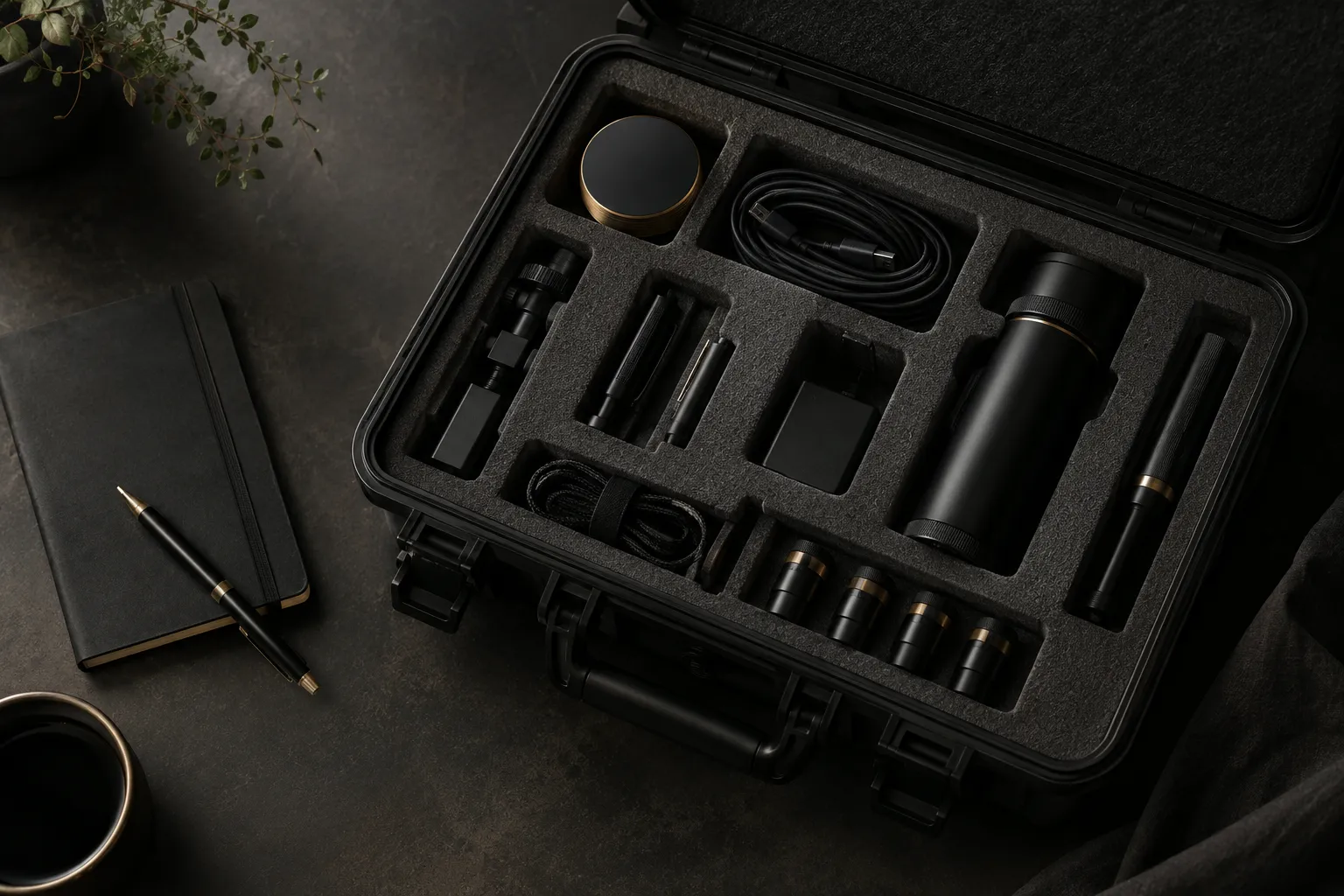
GPS Tracker Evidence in Divorce Court
By Imperial Consulting Unit Inc. · Licensed PI · TSCM Certified
GPS Tracker Evidence in Divorce Court: Detection, Chain of Custody & Ontario Admissibility (2026)
When a marriage ends in contested litigation, every piece of evidence matters. GPS tracking data has become a flashpoint in Ontario family law proceedings — sometimes appearing as legitimate evidence of spousal behaviour, more often as a privacy violation that backfires on the spouse who deployed the device. In 2026, Ontario family courts draw a clear line: evidence gathered through professional, PSISA-licensed investigation survives scrutiny; evidence gathered through self-help surveillance rarely does.
This guide addresses two audiences: the person who suspects they are being tracked and needs court-ready documentation, and the family law attorney who requires a credentialed expert to authenticate GPS evidence and — when necessary — testify. The methodology is the same for both: professional detection, an unbroken chain of custody, and a written report authored under a PSISA licence that can be filed as an exhibit and defended from the witness stand.
Suspect a GPS tracker has been placed on your vehicle during divorce proceedings? ICUnit's Vehicle GPS Sweep service produces a court-ready technical report within 48 hours. Book a confidential consultation to discuss your situation and scope of work.
GPS Trackers in Ontario Divorce: Where Evidence Ends and Violation Begins
Ontario law does not offer a clean answer to the question of whether one spouse may track another. The Criminal Code of Canada, section 184, prohibits the interception of private communications without consent. Section 264 makes criminal harassment — including persistent surveillance that causes a person to fear for their safety — an indictable offence. The Ontario Evidence Act governs what material a court may consider in civil proceedings, and the Canadian Charter of Rights and Freedoms section 24(2) gives courts discretion to exclude evidence whose admission would bring the administration of justice into disrepute.
The practical result: GPS evidence sourced from a device covertly installed by a spouse is routinely challenged, frequently excluded, and can generate adverse cost awards against the party who deployed it. GPS evidence sourced from a professional sweep — where a PSISA-licensed investigator discovers, documents, and removes a device — stands on entirely different legal footing. The investigator becomes the witness, not the tracker. Their PSISA expertise is what converts a physical device into an authenticated exhibit.
The distinction matters most at the motion stage. A spouse who produces a professionally-documented tracker discovery report in support of a restraining order application is in a materially stronger position than one who produces a photograph taken on a personal phone. Ontario courts in 2026 require procedural integrity alongside legal authority.
Ontario Family Law Framework: What Courts Actually Accept in 2026
Ontario family courts evaluate GPS tracker evidence along three axes: relevance, authenticity, and chain-of-custody reliability. A tracker found under a wheel well by an untrained individual, photographed on a personal device, and removed without contemporaneous written documentation will struggle on all three.
Contrast that with a device discovered during a professional vehicle sweep: the technician's sweep log records the exact location, the time of discovery, the device make and model, and the detection method used — whether RF scan, physical inspection, or non-linear junction detector (NLJD) sweep. The device is photographed in situ with measurement scales, placed in a tamper-evident evidence bag labelled with a unique identifier, and described in a signed written report bearing the investigator's PSISA licence number. This creates an authenticated documentary record that can be introduced as an exhibit and supported by expert testimony.
Ontario courts follow the framework established in privacy jurisprudence since Jones v. Tsige (2012) and subsequent family law decisions: location data about a person's movements is sensitive personal information. For that data to be admissible, the collecting party must demonstrate both legal authority and procedural integrity. A professional TSCM report satisfies the procedural integrity requirement. Legal authority is a question for counsel — but the evidence will not be excluded for collection sloppiness.
Family law attorneys practising in Toronto and Ottawa increasingly require PSISA-licensed expert reports before filing GPS tracker evidence in contested proceedings. ICUnit provides that documentation, formatted for court filing and authored by a credentialled investigator available for expert witness testimony.
Where GPS Trackers Hide on Vehicles: What a Professional Sweep Reveals
Consumer GPS trackers are small, inexpensive, and magnetic. A motivated individual can place one in under thirty seconds. A professional sweep covers every location a device can hide — a list considerably longer than most people expect.
- OBD-II port — The diagnostic port beneath most dashboards accepts plug-in trackers that draw continuous vehicle power without any tools or installation. These devices are invisible to visual inspection and emit RF intermittently, requiring scan timing and persistence to detect.
- Wheel wells — The most common hiding spot. A magnetic device attached inside a wheel arch is shielded from casual view by road grime, reaches optimal signal strength away from the vehicle's metal body, and is vibration-resistant through normal driving conditions.
- Undercarriage frame rails — Steel frame members provide strong magnetic attachment along the full vehicle length. Devices placed here require mirror-and-light inspection or lift access; they cannot be found through an external visual scan from standing height.
- Bumper cavities — Front and rear bumper assemblies contain internal void spaces that can conceal a tracker without any magnetic contact surface, making broadband RF detection the primary discovery tool for this location.
- Spare tire well and trunk lining — Passive trackers in sleep mode emit no RF signal between wake cycles. A device stored in the trunk and recovered manually by the installer evades RF sweeps unless physical search accompanies the electronic scan.
- Fuse box and wiring harness — Hardwired trackers drawing from the vehicle's electrical system are the most sophisticated variant and the hardest to locate; detection requires both RF scanning and systematic physical inspection of the harness routing.
A professional TSCM vehicle sweep uses a combination of broadband RF detection, NLJD sweeping to locate unpowered electronic components, and systematic physical inspection with inspection mirrors and directional lighting. ICUnit's Vehicle GPS Sweep protocol covers all six categories. For a step-by-step explanation of the methodology, see our guide to GPS tracker detection on Ontario vehicles.
Chain-of-Custody Protocol: Five Steps to Court-Admissible GPS Evidence
Discovery of a device is the beginning of the evidence chain, not the end of it. Evidence that cannot be authenticated from discovery through to courtroom presentation is vulnerable to exclusion on authenticity grounds. The following five-step protocol governs every ICUnit vehicle sweep conducted in the context of divorce or civil litigation.
| Step | Action | Documentation Produced |
|---|---|---|
| 1. Pre-Sweep Intake | Client identification confirmed, vehicle VIN recorded, scope-of-work agreement signed, purpose of sweep documented (litigation context noted) | Signed intake form with date, time, and investigator PSISA licence number |
| 2. Detection & Location | RF scan conducted, NLJD sweep performed, physical inspection completed; device located, photographed in situ with measurement scale, GPS coordinates recorded | Geo-tagged photographs; scan log with frequency readings; NLJD response notes |
| 3. Evidence Packaging | Device removed with nitrile gloves, placed in anti-static evidence bag, sealed with tamper-evident tape, labelled with unique case identifier, and stored securely | Tamper-evident sealed bag; chain-of-custody form initiated with time stamp |
| 4. Written Technical Report | PSISA-licensed investigator authors report: device identification, detection methodology, location, technical findings, investigator qualifications — signed under PSISA licence number | Signed technical report suitable for court filing as a documentary exhibit |
| 5. Secure Transfer to Counsel | Device and report delivered to client's retaining lawyer with continuity documentation; transfer recorded on chain-of-custody form | Transfer receipt co-signed by receiving counsel or client's authorized representative |
Each link in this chain is documented to prevent any successful challenge to authenticity. A tracker found but not properly documented is, for litigation purposes, a tracker that may not have existed. To understand the broader technical framework underlying professional detection, our explainer on what TSCM involves and how it works provides useful background for both clients and instructing counsel.
Licensed PI vs. DIY Detection: The Court-Admissibility Gap
Consumer RF detectors are widely available and marketed as GPS tracker finders. These tools miss passive trackers in sleep mode, cannot conduct NLJD sweeps of unpowered electronics, produce no sweep documentation, and cannot generate a signed expert report. More fundamentally, the person using them is not a qualified expert, and their account of what the device detected — or failed to detect — carries no weight in Ontario family court.
The Private Security and Investigative Services Act, 2005 (PSISA) establishes licensing requirements for private investigators in Ontario. A PSISA-licensed investigator is a compellable and credible witness whose professional obligations — accuracy, objectivity, contemporaneous documentation — are enforceable by the registrar. When a PSISA-licensed PI reports that a GPS tracker was discovered on a vehicle on a specific date at a specific location, that testimony carries institutional credibility no self-help detection attempt can replicate.
The gap between DIY and professional detection widens further in the context of expert witness qualification. Ontario courts qualify expert witnesses on the basis of training, experience, and recognized methodology. A PSISA investigator with MESA RF Certification and TSCM Certification can be qualified. A self-represented spouse with a consumer detector cannot. The full credential stack — reviewed at ICUnit's About page — is what enables the firm to author reports that survive cross-examination and investigators who can take the witness stand with confidence.
For additional context on the gap between consumer-grade tools and professional sweep equipment in a vehicle context, see our 2026 analysis of GPS trackers and Ontario vehicle security.
Expert Witness Positioning: When Your TSCM Investigator Testifies
In contested divorce proceedings involving GPS tracker evidence, the technical report alone may be insufficient. Opposing counsel will challenge methodology, equipment calibration, and the qualifications of the report's author. The most effective response is a qualified expert witness who can explain in plain language how the device was found, why the detection method is reliable, and what the technical findings mean for the factual issues before the court.
ICUnit is available to provide expert witness testimony in Ontario family court proceedings, civil litigation, and arbitration. Expert witness preparation includes a pre-hearing review of the technical report with instructing counsel, a plain-language summary of findings prepared for the trier of fact, and cross-examination readiness on detection methodology, PSISA standards, and equipment specifications.
Positioning a TSCM expert early — at the investigation stage rather than on the eve of trial — allows instructing counsel to shape the litigation narrative around the technical findings rather than adapting the narrative retroactively. Family law attorneys across Ontario who engage ICUnit at discovery rather than at final hearing consistently achieve smoother evidentiary presentation and fewer contested admissibility arguments. Expert witness engagements are scoped and priced privately — pricing is custom, quoted after a confidential consultation with instructing counsel.
Divorce TSCM Detection: Pricing and Service Timelines
Pricing is custom — quoted privately after a confidential consultation. Scope factors that determine the final engagement include: vehicle size and type, number of vehicles to be swept, whether the sweep is conducted at a fixed client location or requires mobilization across Ontario, and whether the engagement includes a written court-ready technical report (standard for all litigation contexts) or a verbal findings brief for preliminary intelligence only.
Standard turnaround for a single-vehicle sweep with written technical report is 24 to 48 hours from sweep completion. Rush turnaround for pre-filing or pre-motion deadlines is available where scheduling permits. For clients engaged in prolonged proceedings where the risk of re-deployment of tracking devices is ongoing, our Recurring TSCM Membership provides scheduled periodic sweeps throughout the duration of litigation — addressing the reality that a single sweep documents a single point in time, while proceedings can span months.
Family law firms coordinating multiple client matters may benefit from our Bundle Package, which combines vehicle and office sweeps under preferred engagement terms — useful where attorney-client privilege concerns in the boardroom intersect with divorce proceedings in which a client's communications may be compromised. To discuss scope and receive a confidential quote, request a sweep quote through our intake form.
Top Questions Family Law Attorneys Ask About GPS Tracker Evidence
The following addresses the three questions Ontario family law counsel ask most consistently when evaluating GPS tracker evidence for divorce proceedings in 2026.
Will the court accept a private investigator's technical report as expert evidence without a formal qualification hearing? In most Ontario family court matters, the court accepts a brief oral qualification of the expert at the outset of testimony, establishing PSISA licensing, relevant training, and experience. A formal voir dire on admissibility is uncommon in family proceedings but can occur where opposing counsel raises a focused challenge to qualifications or methodology. A thorough, well-documented technical report substantially reduces the risk of a successful challenge.
What if the tracker was placed on a jointly-owned vehicle? Joint ownership complicates but does not resolve the analysis. Ontario courts have consistently held that joint ownership does not confer an unlimited right to surveil a co-owner's movements. Consent must be genuine, contemporaneous, and specific to the tracking activity in question. A professional sweep that locates and documents the device preserves all options — the admissibility question and the consent analysis are for counsel to argue. The investigator's role is documentation, not legal interpretation.
Can the sweep report support a restraining order application? Yes. A sworn affidavit from the PSISA-licensed investigator attaching the technical report can support an urgent motion for a restraining order where the tracker evidence demonstrates harassment or a reasonable apprehension of harm under the Family Law Act. The investigator may be required to attend and be cross-examined if the order is contested at a return hearing — a scenario ICUnit's investigators are prepared for.
Referral Partnerships: How Family Law Firms Engage TSCM Specialists
The most efficient referral relationship between a law firm and a TSCM specialist is established before the immediate need arises. ICUnit works with family law practices across Ontario on a standing-referral basis: when a client discloses suspected tracking, the attorney contacts ICUnit directly to arrange the vehicle sweep, and the resulting technical report is delivered to counsel's office under chain-of-custody documentation within the agreed timeline.
For law firms whose clients face surveillance risks extending beyond the vehicle — including office environments where attorney-client privileged communications may be compromised during contentious proceedings — ICUnit's Office TSCM Sweep service addresses electronic eavesdropping risks in boardrooms, meeting rooms, and executive offices. High-net-worth clients undergoing contested divorce may also benefit from ongoing protection through our Recurring TSCM Membership, which provides scheduled sweeps of vehicle, home, and office throughout the duration of proceedings.
Referral partners receive priority scheduling, a dedicated point of contact, reporting formatted to Ontario civil evidence standards, and investigator availability for expert witness preparation meetings. To discuss establishing a referral arrangement, contact our team directly for a confidential conversation.
Why ICUnit Is Ontario's Litigation-Grade TSCM Authority
Ontario has no shortage of security companies that offer GPS tracker detection. What is rare is the combination of regulatory licensing, technical certification, military-grade counter-surveillance training, and demonstrated court readiness that divorce litigation requires.
ICUnit's principal investigator is a CAF Veteran with operational counter-surveillance experience, holds an active PSISA licence under the Private Security and Investigative Services Act, 2005, carries MESA RF Certification, and is TSCM Certified — each credential representing a distinct layer of technical and regulatory authority that most competing providers cannot replicate individually, let alone in combination. This credential stack is what allows ICUnit to author reports that survive cross-examination and investigators who can take the witness stand without surprises.
ICUnit is mobile across Ontario: confidential vehicle and office sweeps are conducted in Toronto, Aurora, Ottawa, Hamilton, London, Kitchener-Waterloo, Niagara, Barrie, and Kingston. Same-day and next-day deployment is available for urgent pre-filing matters where timeline is critical.
"I came to ICUnit after my lawyer told me we needed documented proof, not just my word that a tracker was there. The sweep team found two devices I hadn't known about, documented everything in writing with photos, and the report held up at our motion without a single objection. Without it, we'd have had nothing." — Divorce litigation client, North York, 2026
Stay Connected
Follow the ICUnit field log on LinkedIn for new Ontario threat intelligence and counter-surveillance updates, and read our Google reviews from past sweep clients to understand the discreet, methodical service standard ICUnit maintains across every engagement.
Frequently Asked Questions: GPS Tracker Evidence & Divorce Litigation in Ontario
Can my spouse's GPS tracking data be used against me in divorce court?
It depends entirely on how the data was collected. Location data gathered through a covert tracker installed without your knowledge or consent may be challenged as a privacy violation under the Ontario Evidence Act and relevant Criminal Code provisions. Courts apply a balancing test: if the evidence was obtained through conduct that engaged Charter rights or amounts to criminal harassment, it may be excluded. A PSISA-licensed investigator can document and authenticate the device, preserving your legal options. Whether the evidence is ultimately admitted is a question for your counsel — but professionally documented discovery gives you the strongest possible position going into any motion or hearing.
What makes GPS tracker evidence admissible in Ontario divorce court?
Ontario courts require GPS evidence to be relevant, authentic, and collected with an intact chain of custody. Authentication typically requires the testimony of a qualified expert — in practice, the PSISA-licensed investigator who discovered and documented the device. The technical report must identify the device, the detection method, the location of discovery, and the investigator's credentials and licence number. Evidence discovered and documented by a licensed professional substantially outperforms self-gathered evidence on every admissibility factor a court considers.
Is it illegal to put a GPS tracker on your spouse's car in Ontario?
Potentially, yes. Under section 184 of the Criminal Code, intercepting private communications without consent is a criminal offence. GPS tracking of a person's movements without consent may constitute criminal harassment under section 264 where it causes the tracked person to fear for their safety. Civil liability under the Ontario tort of intrusion upon seclusion — recognized since Jones v. Tsige, 2012 ONCA 33 — may also arise. The legality turns on specific facts: joint vehicle ownership, whether the tracked person consented, and the purpose of the tracking. These are questions for your lawyer. If you discover a tracker, contact a PSISA-licensed investigator to document it professionally before removal.
How long does a professional vehicle sweep take for divorce evidence purposes?
A standard single-vehicle sweep with written court-ready technical report takes two to four hours on-site, depending on vehicle size and configuration. The written report is typically delivered within 24 to 48 hours of sweep completion. Rush turnaround is available where pre-filing or pre-motion deadlines require it. ICUnit deploys across Ontario and can conduct sweeps at your location, a neutral site (law firm parking, commercial parking structure, or designated secure bay), or a facility of your choosing — whatever best maintains the confidential and discreet nature of the engagement.
Can ICUnit testify as an expert witness in my Ontario divorce proceeding?
Yes. ICUnit's principal investigator is available to provide expert witness testimony in Ontario family court proceedings, civil litigation, and arbitration. Preparation includes pre-hearing review of the technical report with instructing counsel, a plain-language written summary for the trier of fact, and full cross-examination readiness on detection methodology, equipment, and PSISA licensing standards. Expert witness engagements are scoped and priced privately following a confidential consultation with retaining counsel — pricing is custom, not publicly listed.
Get Your Free Quote Today
Call: 905-955-7689
ICUnit delivers discreet, PSISA-licensed GPS tracker detection and court-ready technical reports for divorce litigation across Ontario. Pricing is custom — quoted privately after a confidential consultation. Vehicle sweeps, expert witness preparation, chain-of-custody reporting, and attorney referral packages are all available. ICUnit is mobile across the GTA, Ottawa, Hamilton, Barrie, and beyond — ready to deploy on short notice for urgent pre-filing matters.